How Did Bucci Do? Revisiting John Buccigross’s Alex Ovechkin Goals Projection

Photo by

Photo by “Photonerd23” via Wikimedia Commons

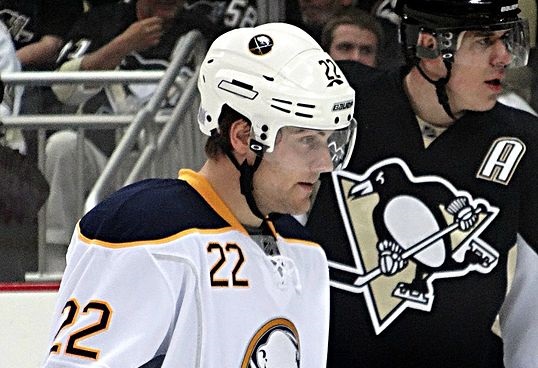
In February of the 2009-10 season, John Buccigross of ESPN was spurred by a mailbag question to do a quick thought experiment: does he think Ovechkin could set the all-time goals mark? Gabe Desjardins voiced skepticism of Bucci’s optimistic projection but didn’t offer a counter-projection, presumably because, as he wrote:

Basically, careers are incredibly unpredictable – nobody plays 82 games a year from age 20 to age 40. And players who play at a very high level at a young age tend to not sustain that level of play until they’re 40…So, to answer the reader’s question: I believe that there is presently no significant likelihood that Alex Ovechkin finishes his career with 894 goals. He needs to display an uncommon level of durability for the next decade, and not just lead the league in goal-scoring, but do so by such a wide margin that he scores as much as Gretzky, Hull or Lemieux did in an era with vastly higher offensive levels.

That said, I thought it would be fun, with five full years gone, to see how Bucci did, and try to build a prediction model with the same data he had available. Continue reading
Increasingly in the NHL, the Best Defense is a Good Offense

Photo by Lisa Gansky, via Wikimedia Commons; altered by author

Photo by Lisa Gansky, via Wikimedia Commons; altered by author

While preparing statistics for a few upcoming posts on on-ice contributions, I decided to do a quick study on the share of on-ice shot attempts taken by defensemen versus forwards. The metric I’m using, which is a spin-off of an old one whose name doesn’t quite capture it right, is what I’m calling on-ice shooting proportion, or OSP. The results were quite interesting, and I decided that I should test the data a little further and see what we could find.

Continue reading

Another Shot Quality Quandary: League Variance, Evolution, Error

File:Alberti-Young-Hockey-Players-alb11bw.jpg

Young Hockey Players” by Piotr Alberti, via Wikimedia Commons

Hockey statistical analysis isn’t really capturing all of hockey, or seeking to package it; it’s about getting as close we can to the essence of the thing. All the ideas, conclusions, best practices that we’ve cobbled together over the years give us an approximation of the actions a team, a player, or a fan could make going forward to better grasp the game.

Within this fact lies the greatest bone of contention for the hockey stats crowd, and the frequent refrain of critics who can only chirp from the sidelines. “Have you considered measuring this? Have you considered measuring that? Have you removed the games when the Rangers lacked sufficient compete level? Have you adjusted for Hamburglar’s pre- and post-lifetime gift certificate to McDonald’s?” While some of these adjustments may be worthy, and others utterly ridiculous, “shot quality” has been a persistent critique of the use of all shot attempts.

Admittedly, there are some interesting developments in Ryan Stimson’s work on puck movement, which might shed some light on an area yet explored. Though it’s not necessarily his focus, I think his data can give us an idea of how possession is maintained effectively. The remainder of shot quality, or at least the way it’s being conceptualized, lies in these remaining areas: type of shot, where shot is located on net, screened/tipped/direct/clear-look shot data, shooting talent, and where on the ice the shot is taken from. The former two, according to Gabe Desjardins, didn’t really demonstrate themselves when he came across the data (nor when I asked him a month ago). Shot location has already died a partial death by Desjardins, who found it seems to have minimal impact on save percentage, though he also found a team talent component, to the tune of differences ranging up to 0.7 feet.

Let me put the location stuff to bed the rest of the way.

Continue reading

When the Trade Market and Draft Market intersect and how to exploit them

Image Courtesy of WikiMedia Commons

The biggest incentive for teams to employ analytics is exploiting market inefficiencies. Whenever you can exploit an inefficiency in a market it gives your team a comparative advantage over the others. In other words, you raise your team’s chances of being a successful club.

I took a look at previous work from Eric Tulsky and Michael Schuckers on draft pick value and used them to show how one may use statistical analysis to take advantage of market inefficiencies.

Let’s take a look.

Continue reading

The NHL Systems Argument: Comparing Bruce Boudreau, Alain Vigneault, & Lindy Ruff

Bruce-Alain Ruff. Looks like the ghost of Gene Hackman. You're welcome for the nightmares.  Composite of images by

“Bruce-Alain Ruff. Looks like the ghost of Gene Hackman. You’re welcome for the nightmares.” Composite of images by “DSCF1837” (Vigneault), Michael Miller (Boudreau), and Arnold C. (Ruff), via Wikimedia Commons*

Systems are without question the most elusive, yet most important, part of our understanding of hockey and the application of analytics. What works and what doesn’t? To what degree can a coach or team apply a strategy?

This led me to think about where we might most convincingly see evidence of a system at work. In the past, we here at HG have had a lot of skepticism about a number of elements of a “system.” For example, Garik’s pieces on competition-matching lines (here and here) and the use of the “defensive shell” to protect a lead, neither of which presented themselves as particularly effective ways of looking at or implementing systems. I have shown in the past that attempts to use extreme deployment in terms of zone starts doesn’t move the needle beyond a 60-40 range of possession, the range of shooting shares for forwards and defensemen haven’t seemed to change much over the last 20-25 years, and a plotting of even-strength shots-for with top and bottom possession teams do not suggest a major difference in shot location.

So where to go from there? Eventually, I decided that we need to get to an extreme enough situation, with robust enough data, where a team might have the best opportunity to dictate a system — in other words, we need to look at the powerplay. The most ideal opportunity for comparison, given the workable data for me, comes from the coaching careers since 2008-09 of Bruce Boudreau, Lindy Ruff, and Alain Vigneault. They all provide at least a couple of seasons with different teams, in addition to a robust set of coaching data from 2008 to the present. Let’s see what we can see…

Continue reading

The Pressures of Parity

File:Balanced scale of Justice (blue).svg

Two nights ago, when no one was looking, I tweeted out a telling statistic to understand how teams have reacted to the salary cap post-lockout.

Boulerice wasn’t the only one scraping the bottom of the barrel in 2005-06; Colton Orr was nearby with his 2:49 per game, and you didn’t have to look much further to see Andrew Peters (3:15) and Eric Godard (3:27). In fact, 19 skaters played over 20 games that season and recorded even-strength TOI/G lower than Peluso’s from this year. Teams have realized that, in a salary-capped league, even league-minimum dollars can’t justify players who cannot be trusted with regular minutes.

This was a fairly stark evolution of player usage, but it led me to wonder if there were any other things we could see by looking at finer-grained data from 2005-06 to the present. The salary cap was a game-changer because it pushed teams at the top and bottom closer together, and that compelled teams to stop employing players they couldn’t trust at evens; what are some other areas we see the pressure of parity?

Continue reading

Who are NHL Coaches Playing More with the (Big) Lead?

Photo by Michael Miller, via Wikimedia Commons

Johan Larsson’s TOI% jumps 8.5% when the Sabres are leading by 2 or more goals (which is never). Photo by Michael Miller, via Wikimedia Commons

Right out the gates, I knew two things: 1) I wanted to take TOI% data from close scores and subtract it from TOI% data from 2+ goal leads, and 2) that it would automatically tell us that perceived poorer players are given more playing time with the lead. Why? Because they tend to play less when the score is close, which increases the likelihood that a differential with 2+ goal time on-ice will show they get to play more with a big lead. That said, I wanted to run a quick study to see just how much of a difference that time swing could be, and which players come out of the woodwork on either end.

But first, I want to whittle away the small sample players, and to do that I’m going to run a quick test to see at what # of games played this TOI 2+ minus TOI Close differential (let’s call it “TOI Lead Diff”) stabilizes.

Continue reading

Spread of NHL Team Shooting Performances, Year-to-Year 1952-53 through 2013-14

Sort of a mid-week quick graph…I’ve been compiling data for a different project and curiosity got the best of me to see what the spread in team shooting percentages was in NHL history. We all know that shooting percentage in the NHL went up substantially during the 1980s, but what you’re seeing above is one of the reasons why we theorize that shot quality and team shooting talent might have figured more greatly in outcomes in the 1980s than it does today. With some exceptions, the standard deviation seems to have settled from about 1996-97 to the present at just under 1%, which suggests our expectations from one year to the next should only allow a team that much of a bump above or below league-average. It’s worth noting that sample will affect this measure, hence why our line is so spiky during the Original Six era, and why 1994-95 and 2012-13 might have not been as characteristic of a trend. Incidentally, this is shooting percentage for all situations.

Note: As mentioned by a reader, increased scoring is going to work together with this standard deviation to accentuate the differences between teams. League-wide, the shooting percentage and standard deviation move well enough together to cause this effect, usually portrayed by coefficient of variance, to regress heavily from 1965 to the present. The exceptions, though muted, would be the early 1980s and the more recent years of Dead Puck, so the standard deviation fairly accurately represents our variance above. CoV data:
Continue reading

Trading Off: How Much Possession Can My Team Surrender and Still Win?

Photo by Michael Miller, via Wikimedia Commons; altered by author

Photo by Michael Miller, via Wikimedia Commons; altered by author

Within the continuing discussions over the value of possession metrics, and the veracity of shot quality or shooting talent measures, there’s a point that seems to have slipped through the cracks. While there’s a spectrum of attitudes about possession and shot quality/talent, neither entirely refutes the importance of the other – and with that thinking, it’s worth considering how much you can sacrifice in one and still maintain success by the other. Put more simply, how little can a team possess the puck and still expect to shoot their way to success?
Continue reading

Goaltender Performance vs Rest

Photo by Michael Miller, via Wikimedia Commons

Photo by Michael Miller, via Wikimedia Commons

I couldn’t find this data (if it’s out there, please point me to it), so I went back to 1987 and pulled goaltender performance vs games rest. We knew goalies did poorly in the second game of a back-to-back pair, but I’m surprised to see such a large gap for two and three games. (The overall dataset is roughly 40000 games.)

Days between Games % of Games Mins (G1) Mins (G2) Shots Vs (G1) Shots Vs (G2) Sv% (G1) Sv% (G2) W% (G1) W% (G2)
1 9.5 54.7 55.0 28.9 29.7 0.905 0.897 0.498 0.421
2 35.6 57.0 56.8 28.7 28.7 0.908 0.901 0.522 0.486
3 19.2 57.1 56.7 29.0 29.0 0.905 0.900 0.514 0.481
4 12.1 56.7 56.3 29.2 28.7 0.899 0.898 0.477 0.487
5 7.2 55.4 55.2 29.0 28.8 0.892 0.899 0.440 0.448

There are lots of systematic issues here (e.g. most back-to-back games are on the road) but simplistically, this would mean goalie rest obscures the bulk of a goaltender’s value. That seems implausible and worth looking at in more detail…