NHL Defensemen and Shooting Contributions back to 1967-68

File:Defenseman Ray Bourque 1979.jpg

Photo by Dave Stanley via Wikimedia Commons

I have kicked around this data in the past, most prominently in my theoretical post on offensive systems, but I really wanted to get further into the intricacies of defensemen and their historical place in team shooting (among other offensive contributions). By looking at how much a defenseman contributes to a team’s shot generation (expressed as a percentage of team shots in the games a player played, or %TSh), we can draw some interesting comparisons across NHL eras, but I haven’t yet explored how the role of the defenseman has (or hasn’t) evolved from the Expansion Era to the present, nor have I taken a look at some of the more exceptional defense shooting teams. Let me correct that now.

Continue reading

Wayne Gretzky vs. Bobby Clarke, December 1981: A Micro-Analysis

Image

Left image by “Centpacrr“, Right image by “Hakandahlstrom” via Wikimedia Commons, both altered by author

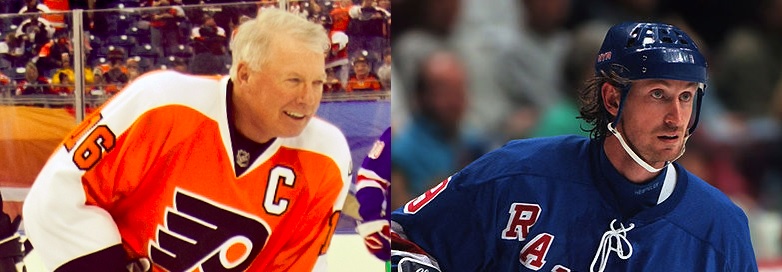
On December 30th, 1981, Wayne Gretzky’s Edmonton Oilers and Bobby Clarke’s Philadelphia Flyers met in a Wednesday night tilt rich with symbolism. Clarke, 32, was a couple of years away from retirement; two of his three remaining teammates from the Cup years, Reggie Leach and Bill Barber (defenseman Jimmy Watson was the third), were themselves out of the league in two years (Leach due to talent drop-off, Barber due to injury). Ironically, there was little indication in 1981 that this was going to happen – all were around 30, all were near point-per-game scorers playing all minutes. Whatever the case, they were the last of the Broad Street Bullies, and were now mentoring a new generation of “Bullies” like Ken Linseman, Tim Kerr, and Brian Propp, who seemed at times more annoying than dangerous. Though in transition, Philadelphia was still a great possession team (4th in the league in 2pS%, an historical possession metric), but fought the percentages all year to squeak into the playoffs. Edmonton, on the other hand, was romping through the league at record pace, and by December 30th held a comfortable lead over 2nd place Minnesota in the old Campbell Conference. Gretzky, of course, was at the heart of this surge, and by game 39 he had 45 goals.

The 1980s Oilers were the next step in NHL offense, really a Canadian version of the 1970s Soviet style of hockey. They didn’t need to bully their way to victories – they let the other team take the penalties, and skated all over them. I should say, that’s what Edmonton would eventually do; on this night they lined Gretzky up with Dave Lumley and Dave Semenko, as they had done most of the year. More on that later.

As I said before, though, the Flyers were a great possession team, as they always had been when Clarke and Barber were in their prime (they averaged, averaged, 55% 2pS% in the years 1973-74 through 1981-82, placing them consistently among the top 5 in the NHL). They were fast and calculating with their puck movement; the grit was just extra work – and who knows, maybe it contributed to Clarke, Barber, and Leach’s early retirement. The Bully when met with the Oilers, though, learned that the box was the bigger enemy.

Continue reading

Why NHL Stats and Scouting Must Work Together

File:2006nhldraft-stage.jpg

Photo by Arnold C, via Wikimedia Commons

I think it’s fair to say that people familiar with hockey scouting and stats analysis know that there is a bit of a rift between the two (not unlike what exists in baseball). The former, as in baseball, has a long history as the standard in hockey analysis, being at-or-near the forefront of drafting, trading, and free agency decisions for teams. The latter is expanding its reach exponentially into league offices, and has many a pro-stats person questioning the abilities of scouts to analyze players (and vice versa). There are at least preliminary attempts to reach out, on the part of Corey Pronman at Hockey Prospectus (and ESPN), but scouting and stats analysis both have a lexicon, methods, and best practices, and devotees of one probably don’t have much time to develop proficiency in the other.

Yet, therein lies a problem and a solution. There is a common thread between these two groups, the desire to usefully analyze hockey players. They each have their own approach, but neither necessarily contain such complicated concepts that they cannot be read by a conscientious analyst. But most importantly, they have something to offer one another that could improve both areas of analysis.
Continue reading

Outperforming PDO: Mirages and Oases in the NHL

Above is the progressive stabilization (game-by-game, cumulatively) of all-situations PDO over time for the 30 NHL teams. It’s a demonstration of the pull of PDO towards the average (1000, or the addition of team SV% and shooting percentage with decimals removed), and it gives you a sense of the end game: an actual spread of PDO, from roughly 975 to roughly 1025. In other words, if you were just to use this data, you could probably conclude that it’s not outside expectations for a team to outperform 1000 by about 25 (or 2.5%) on either side.

That’s all well and good, but PDO is a breakdown of two very different things, a team’s shooting and goaltending, two variables that understandably have very little to do with each other (they are slightly related because rink counting bias usually affects both). Shooting percentage can hinge on a number of contextual variables, though its reliance on a team’s player population usually can bring it a bit in-line with league averages. Save percentage, on the other hand, hinges on one player, and what’s more past performances suggest that a single goaltender can quite significantly outperform expectations. In this piece, I want to jump into the sliding variables of PDO, and what we can expect from teams, but first I want to begin with why I’m working with all-situations PDO.

Continue reading

NHL Systems, NHL History, and Forward vs. Defense Shooting

Photo by “ravenswing” via Wikimedia Commons

“It’s a matter of systems,” “They don’t have a good system,” “There is no system there”…we hear phrases much like this frequently, and I wonder just how much weight we give the word “system” in a game that flows and relies on instinct and reflex. Teams have some kind of system, no doubt, but it’s funny how the actions of any kind of system pale in comparison to the number of times we notice the classic breakout, setting up of the zone, or cycle. What I’m trying to say is, might we be putting too much emphasis on system, when the results are not clearly resulting in different shot quality? Might we be overstating the role of something practiced for a couple of months, maybe a year or two, versus 15-30 years of playing experience, and all the instincts, common tactics, and reflexes?

In my mind, systems are important in-and-of themselves, because their organization principles are intuitive. Cover the man or take away the passing lanes, apply forecheck pressure or trap in the neutral zone…these base ideas probably need to be there to keep things from devolving into pickup hockey. And you all know that game, where everyone’s a superstar forward and nobody backchecks. Seriously, no wonder you guys can’t ever find two goalies.

Anyway, with my current treasure trove of game-by-game, player-by-player data going back to 1987-88 (thanks to Hockey Reference’s excellent Play Index), I wanted to see just how much the game has evolved since the late 1980s, particularly in regards to defensemen involvement in the offense. We already know that the difference in shots-for per team, per game is 30.4 in 1987-88 to 29.1, so not a heck of a lot has changed in shot generation, and the goals/game per team has changed drastically, from 3.71 in ’87-’88 to 2.75 today. This information alone should suggest we probably haven’t improved too much in regards to what we might call offensive systems. Has defensemen involvement increased, and driven the scoring down? Have teams attempted more forward involvement to improve scoring? Will Guy Boucher ever convince us he has the key to better offense again?

I took data from about 30,000 individual player performances in 1987-88 and about 26,000 in 2012-13; I compared the player’s shot totals to their team totals in those games and derived my %TSh, or percentage of team shots metric, previously used in my piece on Career Charting.

Continue reading

Friday Quick Graph: Possessing the Puck in 1969, 1981, and 2013

Hextall OnIce.jpg

Photo by Jim Tyron, via Wikimedia Commons

Just finished tracking possession times in a November 15th, 1969 game between the Flyers and the Leafs. This game, when compared to the games from this post, fits virtually in-between them, which is interesting because, unlike with the other two games, the Flyers and Leafs were two teams on the lower end of the spectrum in the league (8th and 9th in 2pS% in a 12-team NHL). Maybe that also contributes to their average possession time of 6.08 sec (n=349) compared to the 1981 game’s 6.15 (n=364) and 2013 game’s 6.17 (n=360). Another observation among these games: the standard deviation for the 1969 and 1981 games is right around 4 seconds, where it’s right at 5 seconds for the 2013 game. I’ll save any deeper ruminations until I have a larger sample, but it’s food for thought.

Not too long ago, I decided I wanted to try out tracking time of possession in historical games, with the hope of eventually having enough data to look into things. I realized it’s going to be a little difficult to get large enough samples of singular teams, but I also realized that we could potentially compare the game as a whole in different eras. I’ve always been of the mind that the game has evolved somewhat, but at its core there are a number of best practices that have kept it pretty much the same game from around the time that the red line was introduced in 1943. I wanted to test that as far back as I could go, though, so with this possession tracking I actually tracked each individual possession rather than just a total time of possession. For this chart, I displayed all those individual possessions as a distribution, longest possessions to the shortest. These three games, the Philadelphia Flyers vs. Toronto Maple Leafs in 1969 (Toronto won 4-2), Edmonton Oilers vs. Philadelphia Flyers in 1981 (Edmonton won 7-5), and Los Angeles Kings vs. St. Louis Blues (St. Louis won 4-2), had some surprising results when compared. As you can see above, the distribution is actually quite close, with the 1981 game seeming to have shorter possessions but then moving above the others in the middle of the line. The 1969 game actually seems like a trendline of the 2013 and 1981 games. The average possession time? 1969: 6.08 seconds, 1981: 6.15 seconds, and 2013: 6.17 seconds. Obviously, I need (and want) more data, but it is a really intriguing start.

The “possession battle” results?

All Situations Possession

  • PHI (47.1%) vs. TOR (52.9%), 1969
  • EDM (53.4%) vs. PHI (46.6%), 1981
  • LAK (51.7%) vs. STL (48.3%), 2013

Possession, Score Close

  • PHI (41.3%) vs. TOR (58.7%)
  • EDM (48.7%) vs. PHI (51.3%)
  • LAK (51.2%) vs. STL (48.8%)

A Rule of 60-40: Thoughts on Individual Player Possession Metrics

Image

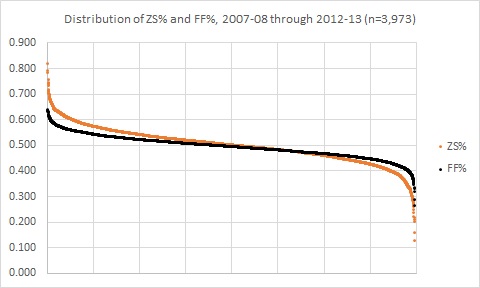
The image above is the distribution of individual offensive zone start percentage (or the percentage of times a player started their shift in the offensive zone) and the distribution of individual Fenwick percentages (shots-for and shots-missed for that player’s team divided by all shots-for and shots-missed, both teams, all tabulated when that player is on the ice). I specifically targeted player season performances wherein the player participated in at least 20 or more games, as that’s roughly around the number of games it takes before these measures start to settle down.

These distributions tell us a few important things for understanding possession, deployment, and how we might analyze the game. Most importantly, after the jump I have a modest proposal, a 60-40 Rule, that might help us in the chase for those elusive, all-encompassing player value metrics.

Continue reading

On Guys Who Score But Don’t Drive Possession

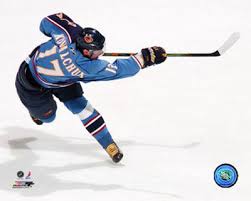
This dude didn’t drive possession much, but MAN what a shot.

Consider four types of forwards:

1.  Forwards who don’t drive possession and don’t score points
2.  Forwards who drive possession forward and score points effectively
3.  Forwards who drive possession forward but don’t score points
4.  Forwards who don’t drive possession but score points.

The first two types of forwards are easy to think about: Type 1 forwards are bad players, not really giving value through their play and Type 2 forwards are the best type of players, those who provide value in both offense and defense and aren’t a liability if they ever go on a cold streak.

Type 3 forwards are a little trickier, but really aren’t that hard to think about – they’re your ideal 4th and maybe 3rd liner, the guy who might not score but keeps your team in the game while your better guys rest.

Then you have your type 4 forwards – the dudes who can score a bunch of points but really don’t keep the puck out of your own zone and in the opponent’s zone.  Perhaps these guys are really bad defensively, perhaps they’re completely inept in the neutral zone, or perhaps they’re guys who score mainly by being in front of the net at the right time, and thus aren’t really being helpful when the puck doesn’t come to them.

How do we value these guys?  Depending upon the point totals these guys can put up, we can value them pretty high actually.  Ilya Kovalchuk was a pretty damn good player who didn’t drive possession much, but his scoring almost certainly made up for what he cost the team otherwise.  Matt Moulson’s hands allowed John Tavares to rack up assists due to his amazing ability to be in the right position to put in goals.  Thomas Vanek likewise.

In a sense, these guys are basically role players.  Of course, that role isn’t being a grinder or a checker or some other name for defensive forward, it’s to be an offensive specialist, paying little attention to anything else.  You’d like to play these guys in positions that maximize that ability like any other role player – so high ozone starts, alongside guys who might complement those skills (playing them alongside guys who don’t have these weaknesses, and thus can make their line a plus possession line, is another typical way to handle these guys).  And scoring lots of points is a pretty important type of role for a player to have.

Most of the time, the best scorers don’t fall into this category – the skills involved with being a plus possession player are the same ones that lead to scoring goals – getting the puck into the zone by carry-in, spending more time in the O Zone, etc.  But a few guys will – think Ilya Kovalchuk or perhaps even the more recent version of Alex Ovechkin (though he used to be a clear driver of play).  These are guys you play as much as possible despite the possession problems simply because well – scoring is what wins games in the NHL.  These guys aren’t that common, so you’ll never see a low possession team dominate for multiple seasons like you did in the 80s (when three teams did accumulate such players).  But you play them anyhow and you try and surround them with a lot of plus possession talent to make up for their shortcomings.

Again, these players aren’t bad by any means – they can even be elite!  Of course, lacking possession driving skills means slumps by these guys will kill you, but for your Kovalchuk’s and Ovechkins, you’ll live with that.

NHL Team History, Possession, and Winning the Stanley Cup

Photo by “JulieAndSteve”, via Wikimedia Commons

Gabe Desjardins dropped a comment over at my Tumblr awhile ago, asking me if I could put together a graph expanding on a metric I came up with, 2-Period Shot Percentage (or 2pS%). 2pS% is an historical possession metric that takes shots-for and shots-against in just the first two periods of a game and expresses it as a percentage for the team being analyzed. The idea was that I was trying to get a rough possession measure from the period that would avoid score effects, or the tendency for teams with a lead to sit on the lead and thus give up shots late in the game. Having recently completed a database of period-by-period shot data going back to 1952-53, I have been able to test this metric a bit and the results were good for 2pS% as a possession measure. Returning to Gabe’s request, he wanted to know if I could chart the 2pS% data from year-to-year, with one line following the league leader in the metric and the other line following the Stanley Cup winner. I’d been curious about this myself; certainly there are a number of different ways to express the value of the metric, but this particular one could be interesting because it toes the line between what the Old and New Guard feel is important in this kind of analysis.

Well, I was right that it would be interesting:
Continue reading

Gauging the Relevance of Quality of Competition on a Player’s Stats – Toronto Maple Leafs’ D Edition

In my last post, I detailed how there is a trend of people placing too much importance on the context behind a player’s statistics, even when such contextual numbers do not at all explain the poor (or great) performance.  Part of this is because old research indicated that quality of competition and zone starts have a much greater impact than more recent research has found to be the case.

In particular, the impact of quality of competition is often dramatically overstated.  This is a little understandable – after all, it should matter a lot who is on the ice against a player at a given time.  And in fact it does:

Graph by Eric Tulsky at http://nhlnumbers.com/2012/7/23/the-importance-of-quality-of-competition – a great post that everyone should reread.

But here’s the key thing:  While it matters if a player is facing Sidney Crosby instead of John Scott at any given moment, the range of competition that a player faces over the course of a season is EXTREMELY SMALL.  The gap between the players facing the hardest competition and those facing the weakest competition is the same as facing an average player at most like 4 shot attempts per 60.  In other words, the guy with the toughest competition in the league will face an average opponent who is +2 corsi/60, while the guy facing the weakest will face an average opponent who is -2 corsi/60.  And nearly all players won’t be in these extremes – most will be within -1 corsi/60 and +1 corsi/60.  And as you might expect the gap between opponents who are +1 shot attempts per 60 and those -1 is practically nothing.

Yet you’ll hear people talk about how one player plays “really weak” competition or another player’s bad #s are because he takes “the toughs” – this doesn’t really mean anything.

This can perhaps be illustrated best by looking at Dion Phaneuf and the Maple Leafs’ D Corp:
Continue reading