Save Percentage vs the Experts: Do shots against inflate a goaltender’s save percentage?

Curtesy of Wikipedia Commons

I’ve seen many statistical articles look at different ways to determine whether or not shot volume inflates a goaltender’s save percentage; however, I’ve never been satisfied with the methods used, regardless of the outcomes. So, I finally went and looked at the data myself.

It’s been seven months since I’ve written anything on save percentage. With all that wait, you’d think I’d give you a big, long, and in-depth article… but I won’t. 

I had one planned, but accidentally lost all my data. Of course, errors always come in clumps. Instead of recovering the lost data, I ended up permanently removing it. To make matters worse, extraskater.com going black made the information a hassle to manually extract again. I probably could write a code (or get someone else) to draw up the information again… but I still have one piece remaining from the original data: the graph.

What is this graph of? What does it mean? Continue reading

Value of Corsi possession measured in goals

The average on-ice shooting and save percentages a player experiences tends to be influenced by their average time on ice per game. This relationship likely occurs due to a combination of factors: shooting talents of linemates and opponent, defensive talents of linemates and opponent, system and psychological effects, and an effect I like to call “streak effects”.
(See bottom for discussion on these effects)

Regardless of the reasons why, these effects indicate that not all Corsi percentages are created equal in impact. This has been discussed previously on Hockey-Graphs both here and here. So, can we measure this difference in impact? Continue reading

How well do Plus Possession Rookie D-Men do in their next few years?

There is nothing perhaps more encouraging to fans of struggling teams than to see a rookie D-Man come up and put up big numbers right out of the gate.  I speak of course, not just about goals and assists – in this case I refer to good possession #s (Corsi, Fenwick, and the relative versions thereabout).  Fans of the Oilers (Marincin), Leafs (Rielly), Isles (de Haan, Donovan), etc, all seem to have higher hopes than they might’ve otherwise due to how well their rookie D has performed.  After all, a top pair D Man (under control for cheap for years to come) can have such a great impact and they are extremely hard to find on the free market (or trade market).

But can these standout rookie D keep up their great performances?  After all, we always hear about the so-called “sophomore slump” and it’s not like players disappointing after great rookie years is that uncommon.  How certain can we be about the futures of rookie D-Men who come up and right away show strong possession #s?  Let’s see how similar rookie D the last few years did.

Continue reading

Perspective On Possession

The more ubiquitous metrics like Corsi and Fenwick become, the stronger their skeptics will argue against them. Though modern analytics have now permeated big-time media and drawn the attention of renowned hockey personalities, they continue to be met with resistance among the more stubborn fans. Somewhere between the polarization of statistics acceptance and complete groupthink is a happy place where opinions may differ but people are knowledgable enough to understand what they’re disagreeing about. I maintain that much of the resistance against advanced statistics is born from a lack of understanding, or a lack of desire to understand. I’ll use Ottawa’s Erik Condra as an example. Condra has been a net relative plus for on-ice possession at even strength for each of his four NHL seasons, yet is seen as expendable by the majority of Senators fans. I’ve heard on multiple occasions that any metric which puts Condra ahead of say, Kyle Turris, must be wrong. What’s getting lost in the shuffle here is that Corsi is not the be-all-end-all stat its doubters perceive it to be. Condra’s CF% REL is telling us he sees a greater share of the 5v5 shot attempts directed at his opponent’s net relative to what occurs when he’s off the ice than Kyle Turris does. Nothing more. This is unequivocal as long as you put trust in the league’s trackers.

There is an axiomatic truth regarding on-ice possession that is seldom spoken albeit intuitive enough not to have to be. Not all possession shares equal worth. The differences that exist between shot rates and shooting percentages while on the ice add or subtract importance to the minutes you play and in turn, the share of shot attempts you generate. At equal CF%, a first-line player’s minutes will hold more value than a fourth-liner’s due to the simple fact more goals are scored in those minutes. It is thus an oversimplification to compare Turris and Condra’s CF% ratings without proper context. A different way to look at possession is to examine the expected goal differential based on shooting percentages we can reasonable expect from the quality of the players on the ice. In other words, how rewarding are a player’s minutes at a set possession share?

Continue reading

The Futility of Predicting Playoff Series Goaltending

Goaltending is a devilishly difficult thing to predict at the best of times. In smaller samples, even the most powerful forecasting tools fall victim to variance and luck. Playoff performances, and to a greater extent single series, represent such samples and we’re frustratingly inefficient at predicting them using traditional methods. I’m excluding more refined models such as @Garik16’s Marcels, which may very well do a better job of it. I compared regular season 5v5 Sv% over different intervals of time, both total and strictly on the road, for all playoff goalies over the past three seasons and how they matched up with playoff 5v5 Sv%. Here are the results:
Continue reading

Evaluating Defensemen using their effect on both team and opponent Corsi%

Courtesy of Wikimedia Commons

Eric Tulsky has previously shown that defensemen have very little control over their opponents on-ice shooting percentages, by demonstrating the extremely low repeatability in the statistic. Recently, Travis Yost expanded on this revolutionary information with showing that on-ice save percentage repeatability is even lower when reducing the impact of goaltender skill level differences; which makes sense when a defender with Ondrej Pavelec is going to have a higher probability of repeating a low save percentage, much like the opposite would be true with Tuukka Rask behind them. This leaves a defender’s influence on shot metrics as their primary impact in improving the team’s chance in winning the game. Tyler Dellow then pushed it one step further by stating the best method of evaluation then is using a defenseman’s impact on a team’s Corsi%.

But, there is one other primary factor: how a defender impacts the opposition. The two are not exactly one in the same, even though they are related:

Continue reading

Projecting Future Goalie Performance: Updating and Improving Hockey Marcels

In February, I introduced my hockey version of Baseball’s Marcel forecasting system – a system that uses the last few years of a player’s career, weights the more recent seasons more heavily, and uses that to project future performance.  In particular, I was using the system to take an attempt at projecting goalies – who are of course the most unpredictable of hockey players.

Now that the season is over, it’s time to take another stab at goalie projections using Marcels. However, we can do better than we did last time: last time, our projections used Eric’s weights plus a mostly arbitrary regression mechanism. This time, we can use a more realistic (and non-arbitrary) regression as well as attempt to account for aging as well. In short, we SHOULD be building a better projection system for goalies, the most unpredictable of players.

Continue reading

How well do goalies age? A look at a goalie aging curve.

This guy may be lying flat on his face like this more and more often as he’s reaching the big 35.


A few weeks back, I unveiled Hockey Marcels: an extremely simplistic system for projecting goalies performance going forward, utilizing just the last four years of a goalies’ play to do so. Building off of work by the great Eric T., I weighted more recent years more heavily than older ones, to try and give a better estimation to what we should expect from goalies going forward.  In addition, I added a regression factor to Eric’s work, such that we could deal with varying sample sizes and the extreme variability of NHL goaltending.

But the one thing I didn’t include was an aging adjustment.  This is an integral part of any serious projection system for the obvious reason:  Using past years to project future data is sound, but players will be OLDER in the future and increased age generally results in worse performance (except for the really young).  This is especially the case with hockey, where peak performance has been found to be at ages 24-25.   If we really want to project goalie performance going forward, we need to find out how well goalies age.

A few people have looked at this before (both Eric and Steve Burtch have written about goalie aging in previous posts), but I wanted to actually get #s rather than just a graph on how aging affects goalies of all ages.  So I used hockey reference to get the seasonal data of all goalies from 1996-1997 to the present season who had played 20 years, and tried to take a look.

Continue reading

The Day David Staples Killed Corsi Because…Taylor Hall

File:Taylor Hall.JPG

Photo by Alexiaxx, via Wikimedia Commons

I’ve been following the story of Taylor Hall as the season progresses, particularly through Tyler Dellow’s attempts to un-vex the vexing year Hall is having (Parts IIIIIIIV). In Tyler’s second part, he notes three differences between this year and last year: fewer zone entries with a carry, poorer retrieval of dump-ins, and a lower shots-per-carry total. The latter, Tyler notes, is likely symptomatic of a larger emphasis on dumping-in, wherein a player carries to just inside the blue line before dumping. He quotes Dallas Eakins as suggesting that Hall, in-particular, seems to take this dumping-in approach to heart. I’d add that there’s a possibility that this is abbreviating potential offensive zone possession time, as overall Hall and the other Edmonton Oilers have dropped from nearly 50 seconds per shift to 47 seconds. Further to that point, Tyler noticed in the fourth part that the Oilers have seemed to adopt a tip-in dump-in, wherein the player in the neutral zone either redirects or chips, while standing in place, the puck into the offensive zone. Just based on the video evidence Tyler provided, this looks like an extraordinarily passive approach to the dump, equivalent to dumping and getting off the ice. In that latter scenario, you are unequivocally giving up possession. In the tip-in approach, you take your active close player and leave them in-place, in favor of a later-to-the-game forechecker. It would seem to me that you’d benefit from an active dump-and-chase forechecker.

There are a couple of others irons you can put in the fire, including variance of CF% (a 5% swing is not unheard-of, particularly moving from a 48 to a 56-game sample), potential fatigue from increased playing time (he’s taken on some penalty kill minutes and more even-strength minutes this year), and the swapping out of Ales Hemsky as a linemate (for Sam Gagner). The tougher competition, for me, is essentially washed out by a bump up in offensive zone starts. I don’t see evidence of recording bias, either. I suspect a couple potential, additional things: 1) the drop-off is right there with the Ovechkin-Dale Hunter drop-off, so there might be some player vs. system aggravation, and 2) some fatigue issues related to the early-season knee injury. Injuries aren’t just about pain, they can also compromise strength and endurance. A guy like him, who has had injury issues in the past, does not want the “soft” label (you’ve seen what that’s done to Hemsky’s time in Edmonton), and might not want to admit it to the media or himself.

Up to this point, you’ve seen Dellow’s and my own introspection into what appears to be a poor possession season from Taylor Hall. Enter David Staples.

Continue reading

Friday Quick Graph: How the Possession Battle Stabilizes

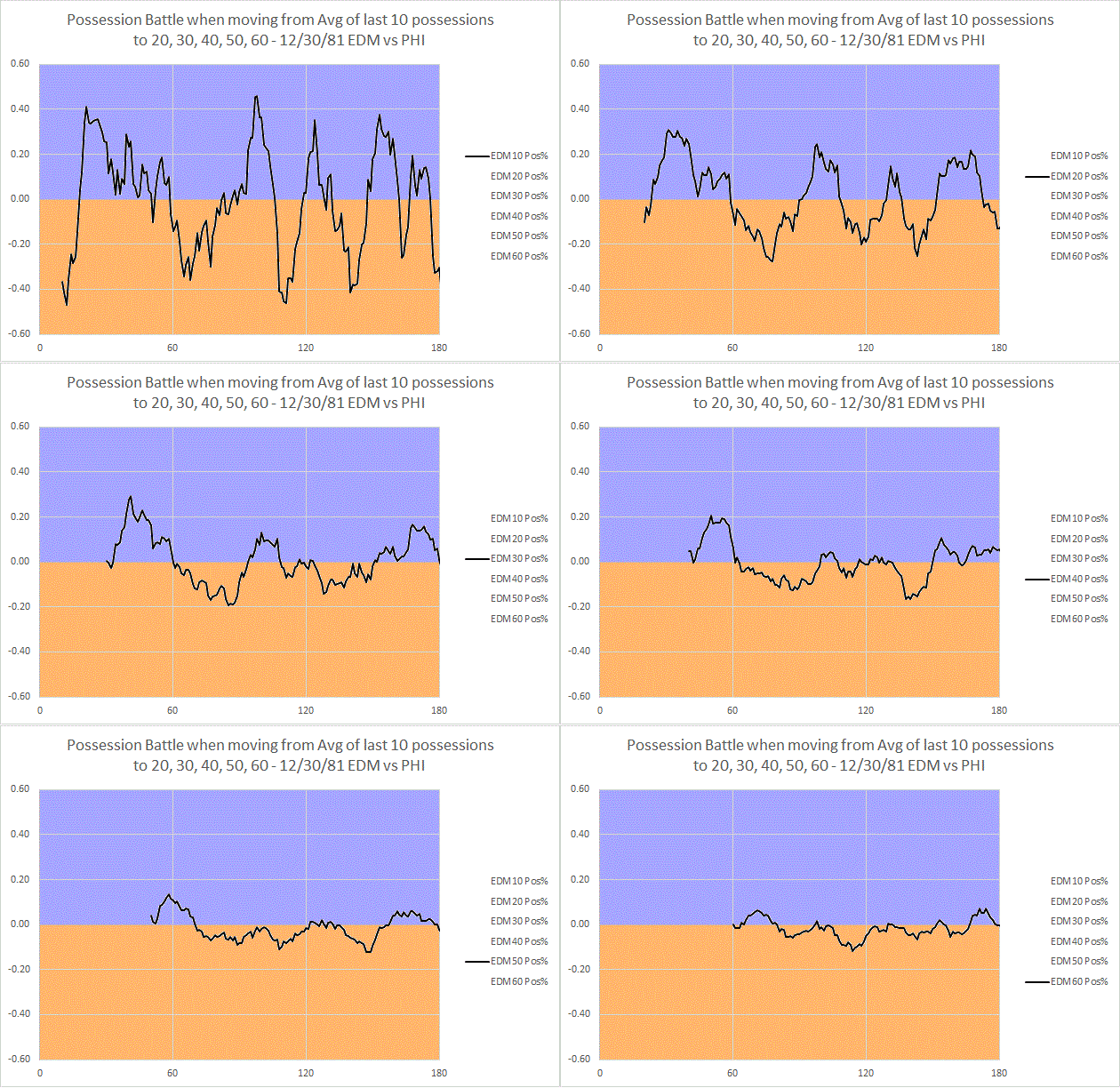
Surely you’ve been exhausted with graphs from this December 30th, 1981 Oilers-Flyers game, but allow me one more. I wanted to demonstrate both how many possessions it took for the possession battle to grant us a clear picture, and also further speak to the value of 2pS%. The chart above demonstrate what happens when I establish a rolling possession-for % (as indicated by the y-axis, possession-for % is done from the perspective of Edmonton) using the last 10 possessions, then the last 20 possessions, and so on to 60 possessions. I stop there because we then arrive at a point where we are primarily measuring (in 60-120 on the x-axis) the 1st and 2nd period in-tandem. What we see is that, by that point, our possession battle has calmed down much closer to something that resembles the final battle (a 52% to 48% victory for Philadelphia). The y-axis shows how far above or below .500 (or 50% possession) the battle went; once again, this was measured from Edmonton’s perspective, so below the line is Philadelphia winning the battle, above is Edmonton (hence the color-coding). We also see, then, that the battle doesn’t calm down to a spread below the 60-40 possession benchmark until 40 possessions…which means it doesn’t really reach the likelihood of truly reflecting demonstrated possession talent until that point. For this reason, I think we can derive confidence in the signal that two-periods provide us with regards to possession battles. Additionally, it speaks to the potential problem with focusing on single periods of data.