Has the NHL’s new faceoff rule increased goal scoring?

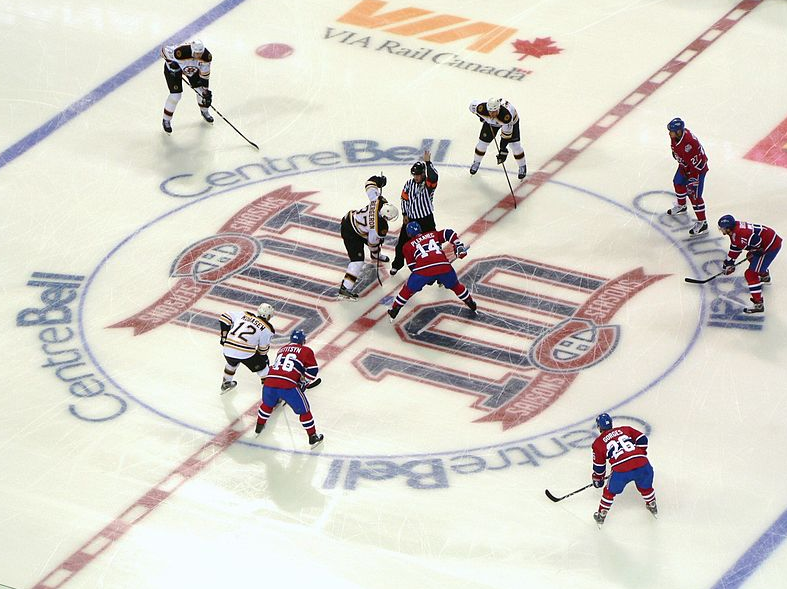
Mise au jeu BOS @ MTL Faceoff” by Fleurdelisé. Licensed under Creative Commons via Commons.

Over the summer, the NHL made a number of significant rule changes to make the game more entertaining to fans and more fair for teams, with 3-on-3 overtime being the most revolutionary and thus far the most applauded.

Buried down at the bottom of the list of rule changes, however, was a much less significant note. It involved faceoffs – you know, that thing data analysts get peeved at commentators for overemphasizing. For years, the standard procedure has been that the visiting team’s player is required to put his blade on the ice prior to his opponent. This is an advantage for the home player, as he can attempt to secure the puck back to his side with one consistent motion rather than having to move his stick forward and then backward.

Continue reading

How can we measure a goalie’s rebound control? Examining Pekka Rinne and James Reimer.

Embed from Getty Images

Pekka Rinne is good at controlling his rebounds. I know this, because people on the internet have made their opinions abundantly clear. Scouts and fanalysts alike credit Rinne’s quick glove hand with helping him catch a significantly higher volume of shots than most other goalies, leaving few opportunities behind for lurking opponents to deposit into his net.

James Reimer is not good at controlling his rebounds. I know this, once again, because people on the internet have made their opinions abundantly clear. Reimer’s (supposed) inability to prevent the shots he’s saved from bouncing into dangerous areas is often cited as one of the main reasons for why he should be the #2 goalie behind Jonathan Bernier on the Leafs’ depth chart.

Continue reading

The 2015 OHL Final Part One: Erie Otters Passing Network

At the Rochester Hockey Analytics Conference, Stephen Burtch presented on Network Analysis using our passing data from last season. You can access Stephen’s slides here. It was an intriguing presentation on how we can use the passing data to better understand the on-ice environment of players and teams. If you’re at all familiar with my work, you won’t be surprised to hear me say that what happens prior to a shot being attempted is something that escapes us and is more important than just the final act of shooting. Only in better understanding how things happen, or don’t happen, prior to that, will we be in a better place to properly evaluate players. When Stephen presented at #RITHAC, I was sitting there thinking, “Boy, this would be great to do with the 2015 OHL Final Passing Data” I’d tracked, but hadn’t gotten around to sharing the results.

Continue reading

Hockey Talk: Why the layman eye-test and results sometimes differ for defenders?

Patrick Wiercioch - Ottawa Senators.jpg
Patrick Wiercioch – Ottawa Senators” by Lisa GanskyFlickr: IMG_6499. Licensed under CC BY-SA 2.0 via Commons.

Hockey Talk is a (not quite) weekly series where you will get to view the dialogue amongst a few of the Hockey-Graphs’ contributors on a particular subject, with some fun tangents.

This week we look at what makes up an effective defensemen and why the eye test sometimes differs from the results:

Continue reading

Exploring the Impact of New NHL Coaches and GMs

With Todd Richards being let go after a disastrous 0-7 start by the Blue Jackets, and Bruce Boudreau on the hot seat (heck, he might be out of a job by the time I finish writing this), coaching is once again in the spotlight. After Richards was fired, I went on a mini rant about how I believe having a good GM is more important than having a good coach, and while I still believe this is true, I wouldn’t be a data person unless I tried to prove it.

This project has many parts to it. The first, which I’ll be doing here, is just looking at the breakdown of Scoring Chances For% compared to Coaches and GMs in the early days of their tenure, i.e. right after being hired. Scoring Chances, to simplify things, are basically “more dangerous shots” (click here for a more rigorous definition).

To start, I needed data. I pulled all 30 teams from 2006/07 to 2015/16, and coded each season by what kind of organizational changes happened within. This gave me 331 data points, as there were often midseason coaching or GM hirings to account for.

The states broke down like this:

1) No Change – 64%
2) Hired a new Coach – 21.5%
3) Hired a new GM – 7.3%
4) Hired a new Coach & new GM – 7.3%

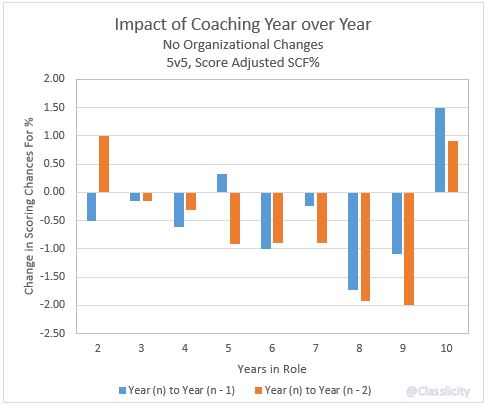
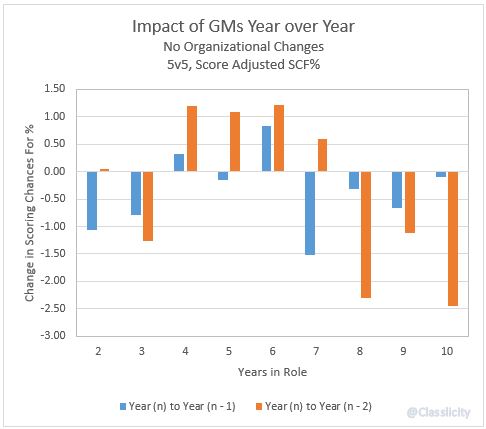
In looking at the data, some patterns quickly emerged. The first two years of tenure in either role were where the most change, for better or worse, happened.

Because I had so much data in the No Change category, I wanted to see if there was any sort of trend year over year for the control group.

No Changes - Coaches SCF Delta YoY

No Changes - GMs SCF Delta YoY

Continue reading

Practical Concerns: A better way to evaluate defensemen

Credit: Michael Miller - Creative Commons

Credit: Michael Miller – Creative Commons

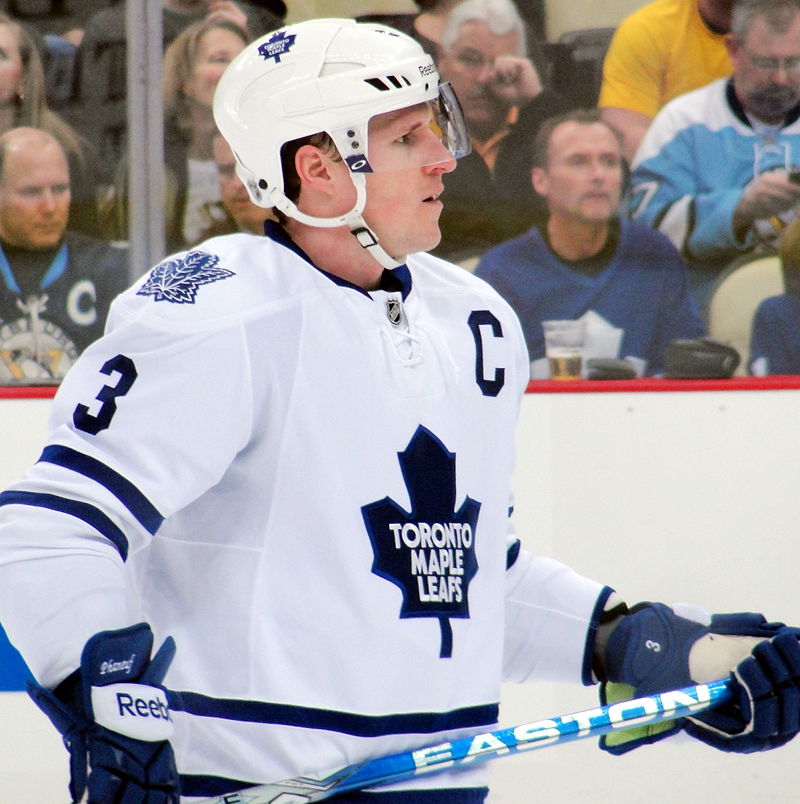
I was watching hockey a few nights when I heard NBC’s Pierre McGuire describe a rookie defenseman in glowing terms. It was the same kind of praise he used to shower upon Dion Phaneuf about 10 years ago, and this young player had very similar attributes to an early-20s Phaneuf: a huge frame, a huge slapshot, and a willingness to use both in equal measures.

Continue reading

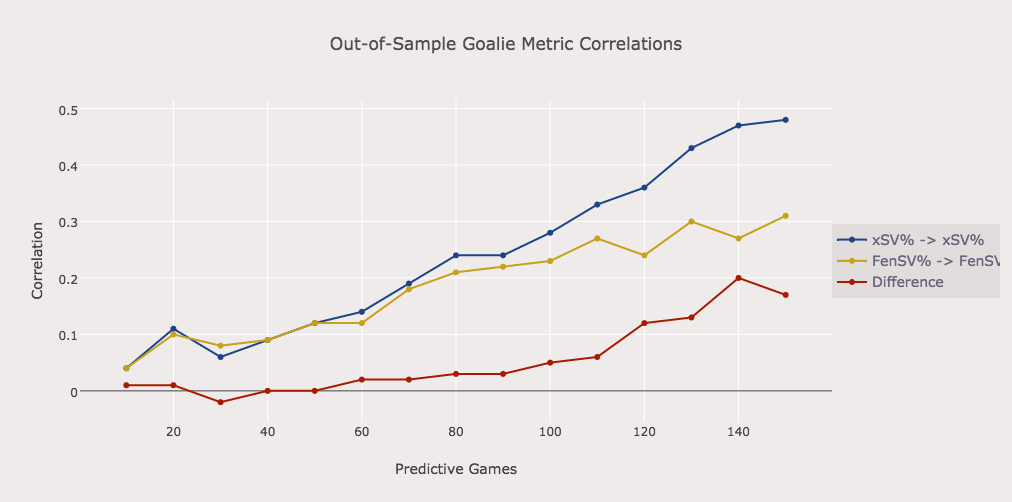
xSV% is a better predictor of goaltending performance than existing models

This piece is co-authored between DTMAboutHeart and asmean.

Analysis of goaltending performance in hockey has traditionally relied on save percentage (Sv%). Recent efforts have improved on this statistic, such as adjusting for shot location and accounting for goals saved above average (GSAA). The common denominator of all these recent developments has been the use of completed shots on goal to analyze and predict goaltender performance.

Continue reading

Revisiting Imbalanced Drafting Strategies

Photo by user

Photo by user “Tsyp9”, via Wikimedia Commons.

At Hockey-Graphs, we like to provide data-based answers to questions. It’s what we do. But it’s also good to recognize issues in the analytics world that haven’t yet been addressed. Sometimes that’s the case because we don’t have the data we need available, and sometimes it’s because the question has yet to be properly framed. It’s important to know what we don’t know, and to talk about it regardless.

There has been some great draft work done at our site and elsewhere in the last few years, and one of the findings has been the volatility of drafting defensemen relative to forwards. Couple that with claims that forwards have more of an impact on shot rates than defensemen, and one would be tempted to claim that avoiding defensemen altogether would be a solid draft strategy (though I’ll note that most analysts think this is taking the conclusion too far).

Continue reading