Friday Quick Graph: Player Career Charting by Percentage of Team Shots, 1967-68 to 2012-13

Embedding interactive graphs into blog posts, especially blogs with a narrow runner like ours, is frequently an awkward process. Just about the time things look good, you tinker with it and it looks bad. Nevertheless, I had a bunch of old data I put together, once upon a time, and I wanted to get it out there in a form that you could tinker with. Basically, in the past I have used the percentage of team shots in the games a player participated (%TSh; explanation here) as a way to capture a player’s contribution to the shot load; I also think it strongly implies a player’s involvement and contribution to team offense overall.

In the case of today’s graph, I took %TSh and looked at aging curves with a multitude of players from 1967-68 through 2012-13 (like I said, the data is a little old). I prepared this with a selected group of players available for the filter, the majority of whom are stronger, more familiar players of the years covered. I also included some players that struggled by the metric, for the sake of comparison. To filter, click on the “Name” bar, click on “Filter,” and let your imaginations run wild. Feel free to download if you wish.

Note: I believe I set the cut-off at 20 GP before I would record the point of data. It’s old. I’m old. We’re all getting older.
NHL Forwards vs. Defensemen Height & Weight, 1917-18 to 2014-15

Photo by Eric Kilby, via Wikimedia Commons

Photo by Eric Kilby, via Wikimedia Commons

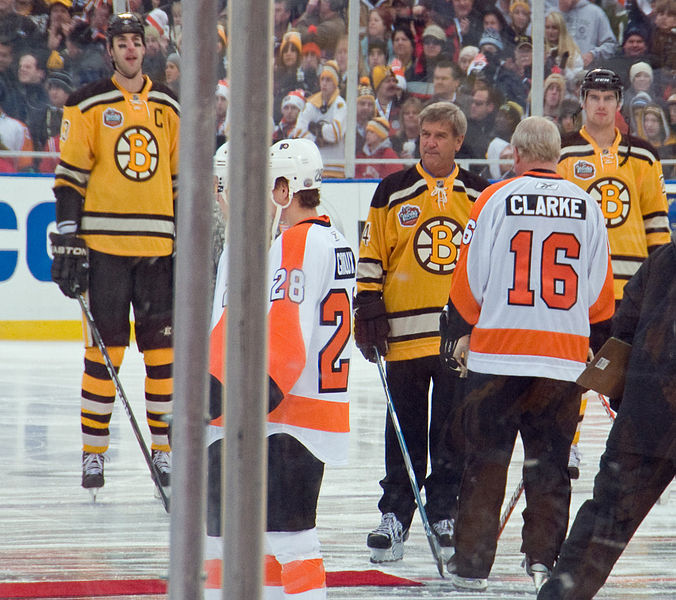
Building on my post from last week on overall skater height going back to 1917-18, I wanted to dig a little further into the the complexity of the data to see if there were any interesting takeaways. This included breaking the data into forward and defense data, to see if there was every any substantial increase in defenseman size or any other allusions to an attitude change in terms of size trends and preferences. While there are some slight differences, most interesting to me was, for as many changes as the NHL has undergone, there seems to be a uniform attitude about size when looking at forwards and defensemen.
Continue reading

The Goal Impact of Even Strength Faceoffs for NHL’s top 100 Faceoff Centres

Jackets-Canucks Face-off.JPG
Jackets-Canucks Face-off” by Leech44Own work. Licensed under CC BY-SA 3.0 via Wikimedia Commons.

A debate was ongoing on twitter over faceoffs and their value. The debate lead to most of this data being scraped anyways, so I thought I would display everything for your viewing pleasure.

The truth is, faceoffs tend to be highly overrated. They matter, but they do not matter on average much more than any other of the many puck battles that occur throughout the game. When you really break it down, faceoffs are really just a set play puck battle after all. However, some have more values than others.

Let’s take a look.

Continue reading

NHL Player Size From 1917-18 to 2014-15: A Brief Look

Image by Erich Schutt, via Wikimedia Commons

Image by Erich Schutt, via Wikimedia Commons

As any person interested in hockey stats should do, I’ve been gradually building my own personal database of player information that I can use when Y3K robs my future post-human self of cloud data for 3 seconds. To that end, player size wasn’t a huge priority but I knew eventually I’d want to have it, if only to think about how normal-sized I’d be in the 1920s NHL. In the process of bringing in all that data, I decided to do a little demographic work on player height and weight. We all know the players are bigger now than they were before, but by how much? And is there greater variance in size now or in the past?
Continue reading

Regular season hit differentials and the playoff success

Milan Lucic Stanley Cup celebration.jpg
Milan Lucic Stanley Cup celebration” by Ashley Bayles from Canada – IMG_5526. Licensed under CC BY 2.0 via Wikimedia Commons.

Last time we looked at the relationship between hit and goal differentials. We showed that the outhit team tends to also be the outscoring team.

On Twitter, the subject of playoffs naturally came up. Do physical teams get an edge in the post-season?

I’ve been already pulling some data on the playoffs and doing some studies. I thought this would be a good opportunity to show a few of my early findings.

Continue reading

The Usefulness (or lack thereof) of Hit Totals

From Wikimedia Commons

The hit statistic rivals the faceoff in praise by some more traditional hockey analysts. Both statistics are also similarly over valued in terms of their impact to the game. There has been work previously shown that the hitting statistic actually has a negative relationship with winning.

I wanted to look into this just a  little bit further. I went to War-On-Ice and downloaded data for every NHL game since October 2007. I then cleaned the data and took a little look. Continue reading

2015 Midseason Goalie Projections using Hockey Marcels

Last Year, I unveiled a hockey version of the baseball Marcels forecasting system in an attempt to forecast the future performance of goalies.  The idea behind Marcels is simple: we take the last few years of a player’s performance and then weight more recent numbers higher than older numbers.  In addition, we regress the player’s #s to the mean (with a player who has a larger sample being regressed less than one with a smaller sample) and, if we’re projecting for the future, we adjust the overall #s for aging.  Again, this is a very very basic projecting system, but its’ been proven to be incredibly well founded for baseball, and probably for hockey as well.

So let’s take a look at how things have changed now that we have data from the most recent season.  We now have a few goalies with enough data to run Marcels on that we didn’t previously (although barely in most cases) and a few goalies have had large turns in one way or another in their career, which changes the projections.

Again, as a reminder, here is our methodology:
Continue reading

Trading Off: How Much Possession Can My Team Surrender and Still Win?

Photo by Michael Miller, via Wikimedia Commons; altered by author

Photo by Michael Miller, via Wikimedia Commons; altered by author

Within the continuing discussions over the value of possession metrics, and the veracity of shot quality or shooting talent measures, there’s a point that seems to have slipped through the cracks. While there’s a spectrum of attitudes about possession and shot quality/talent, neither entirely refutes the importance of the other – and with that thinking, it’s worth considering how much you can sacrifice in one and still maintain success by the other. Put more simply, how little can a team possess the puck and still expect to shoot their way to success?
Continue reading

The relationship between Corsi% and winning faceoffs.

Faceoffs have always been an interesting area of research. There have always been individuals in the media and public who extol faceoffs importance; I have even heard quotes like: puck possession is so important and you cannot win the puck possession battle if you are starting without the puck.

Not too long ago Gabriel Desjardins showed that the impact of a faceoff is real (as one would expect) but likely over glorified by some. One example from his study showed shot rates after an offensive zone faceoff:

From these numbers Desjardin estimated an impact of +2.45 goals for every 100 non-neutral zone faceoff wins over 50%, and +3.66 for every 100 for special teams. A real impact, but not overly huge impact. Neutral zone faceoffs carried even less of an impact with +0.90 goals for every 100 faceoffs over 50%.

But what about faceoffs overall relationship with possession? Continue reading