Friday Quick Graph: NHL 5v5 TOI Peak at 24, 25 Years Old

This is the distribution of the skater performances w/200+ 5v5 TOI from the seasons 2007-08 through 2011-12 (n = 3,334). Use as reference for the below two charts. Notice that our line gets a little wacky as our n drops near the tails.

Some of you already know this, but I enjoy distributions, and I think they get sorely under-used in analysis (although, in the end, they are the basis of predictive work). This piece is a bit old (the data is across all skaters, 2007-08 through 2011-12, n = 3,334), but it shows the number of skaters with 200+ minutes of 5v5 time at each age grouping. The peak is clearly at 24 or 25 among this group, but we should be clear with what “peak” means. Although even-strength time can be a pretty good indicator of overall player talent, it’s still a shaky signal (c’mon, we know not all coaches put the “right” guys out there sometimes). Further, powerplay time can sometimes be a drag on better players’ energy for even-strength time, which can also compromise this signal. Nevertheless, if you were to sort all players into even-strength time groupings (say, forwards in 4 groups by ESTOI, and defensemen in 3 groups by ESTOI) you’d see that the top would generally perform better possession and offense-wise than the second, and so on down.

With that in mind, “peak” is also about health. Though we’ve not had much research into it (hint, hint), we have reason to suspect that injuries might drag on possession measures a bit. That said, 24-25 can also be a performance peak for the reason that players are less likely to have major injuries until that age or later.

I plan on digging into this data again (now that I have my ES data back to 1997-98) and splitting into forward and defense groups, but this is a good start.

The Day David Staples Killed Corsi Because…Taylor Hall

File:Taylor Hall.JPG

Photo by Alexiaxx, via Wikimedia Commons

I’ve been following the story of Taylor Hall as the season progresses, particularly through Tyler Dellow’s attempts to un-vex the vexing year Hall is having (Parts IIIIIIIV). In Tyler’s second part, he notes three differences between this year and last year: fewer zone entries with a carry, poorer retrieval of dump-ins, and a lower shots-per-carry total. The latter, Tyler notes, is likely symptomatic of a larger emphasis on dumping-in, wherein a player carries to just inside the blue line before dumping. He quotes Dallas Eakins as suggesting that Hall, in-particular, seems to take this dumping-in approach to heart. I’d add that there’s a possibility that this is abbreviating potential offensive zone possession time, as overall Hall and the other Edmonton Oilers have dropped from nearly 50 seconds per shift to 47 seconds. Further to that point, Tyler noticed in the fourth part that the Oilers have seemed to adopt a tip-in dump-in, wherein the player in the neutral zone either redirects or chips, while standing in place, the puck into the offensive zone. Just based on the video evidence Tyler provided, this looks like an extraordinarily passive approach to the dump, equivalent to dumping and getting off the ice. In that latter scenario, you are unequivocally giving up possession. In the tip-in approach, you take your active close player and leave them in-place, in favor of a later-to-the-game forechecker. It would seem to me that you’d benefit from an active dump-and-chase forechecker.

There are a couple of others irons you can put in the fire, including variance of CF% (a 5% swing is not unheard-of, particularly moving from a 48 to a 56-game sample), potential fatigue from increased playing time (he’s taken on some penalty kill minutes and more even-strength minutes this year), and the swapping out of Ales Hemsky as a linemate (for Sam Gagner). The tougher competition, for me, is essentially washed out by a bump up in offensive zone starts. I don’t see evidence of recording bias, either. I suspect a couple potential, additional things: 1) the drop-off is right there with the Ovechkin-Dale Hunter drop-off, so there might be some player vs. system aggravation, and 2) some fatigue issues related to the early-season knee injury. Injuries aren’t just about pain, they can also compromise strength and endurance. A guy like him, who has had injury issues in the past, does not want the “soft” label (you’ve seen what that’s done to Hemsky’s time in Edmonton), and might not want to admit it to the media or himself.

Up to this point, you’ve seen Dellow’s and my own introspection into what appears to be a poor possession season from Taylor Hall. Enter David Staples.

Continue reading

A Rule of 60-40: Thoughts on Individual Player Possession Metrics

Image

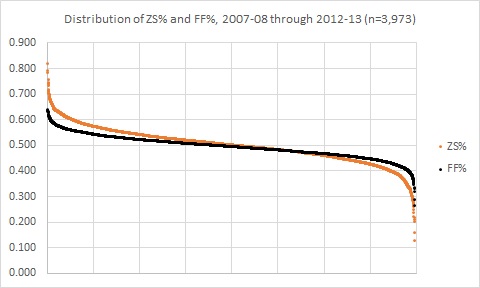
The image above is the distribution of individual offensive zone start percentage (or the percentage of times a player started their shift in the offensive zone) and the distribution of individual Fenwick percentages (shots-for and shots-missed for that player’s team divided by all shots-for and shots-missed, both teams, all tabulated when that player is on the ice). I specifically targeted player season performances wherein the player participated in at least 20 or more games, as that’s roughly around the number of games it takes before these measures start to settle down.

These distributions tell us a few important things for understanding possession, deployment, and how we might analyze the game. Most importantly, after the jump I have a modest proposal, a 60-40 Rule, that might help us in the chase for those elusive, all-encompassing player value metrics.

Continue reading

Friday Quick Graph: The Evolution of an NHL Forward’s Time On-Ice

Friday Quick Graphs are (initially) intended to revisit some of the better, potentially more-significant work I’ve posted over the past year on my Tumblr page (if you want to beat me to some of them, take a look at benwendorf.tumblr.com).

I did a similar GIF one week ago, using defensemen, in an effort to understand how a player’s playing time evolves over their career. Taking NHL player data from 2007-08 through 2011-12 and identifying year-t0-year change, I’m able to create a hypothetical forward that plays from age 18 to age 40, and how that player’s ice time would change.

For frame of reference, the hypothetical player is the dark blue triangle, the light, dotted triangle is the league average across the player population, and the light blue triangle is the league high in each situation.

There are some similarities to the defensemen GIF, primarily that player’s are given powerplay minutes early, but grow into penalty kill minutes. Unlike defensemen, though, forward TOI decreases uniformly at all strengths, whereas defensemen tend to retain some of their penalty kill time.

As with the previous post, it’s worth pointing out that a player playing from age 18 to age 40 would be a pretty unique, talented player, so this model is really just to demonstrate change.

Friday Quick Graph: The Evolution of an NHL Defenseman’s Time On-Ice

Age progression TPCs for a hypothetical defenseman who has played from age 18 through 40. The progression is built on year-to-year age trends across the entire NHL defenseman population from 2007-08 through 2011-12.

Friday Quick Graphs are (initially) intended to revisit some of the better, potentially more-significant work I’ve posted over the past year on my Tumblr page (if you want to beat me to some of them, take a look at benwendorf.tumblr.com).

What you see above is a “Total Player Chart,” or TPC, a chart I developed about a year ago to visualize a player’s time on-ice (TOI) deployment. Using that chart, I took the NHL player population from 2007-08 through 2011-12 and recorded the year-to-year change in player’s TOI relative to their age and age +1 seasons. I took those trends and placed them upon an average 18-year old defenseman’s ice time, and tracked how that hypothetical player’s TOI would evolve if they played to the age of 40. The result is the GIF above.

For frame of reference, the hypothetical player is the dark blue triangle, the light, dotted triangle is the league average across the player population, and the light blue triangle is the league high in each situation.

As you can see, the trend is that young player’s tend to receive 5v4 minutes, and as they age they become more trusted with 4v5; as they get older, the 4v5 minutes stick around, but the 5v4 minutes fade.

It’s worth pointing out that this hypothetical defenseman, overall, is likely to be a decent player, by virtue of the fact that they would be getting NHL minutes at age 18 in the first place (and playing until 40).

Replacing Steven Stamkos: How the Tampa Bay Lightning Weathered the Storm

File:Steven Stamkos.JPG

Photo by “Resolute”, via Wikimedia Commons

One of the more remarkable and underreported stories of this season has been Tampa Bay’s continued competitiveness despite the loss of the NHL’s most dangerous sniper. You could hear the wind whoosh out of Lightning fans’ sails when Stamkos went down in November, and for good reason. Martin St. Louis’s Art Ross Trophy aside, Stamkos was the driving force behind the Tampa Bay attack.

Yet, at the time of this post, the Lightning are 3rd in the Eastern Conference, and 7-2-1 in their last 10 games. What changed when Stamkos went down? How has Tampa Bay managed to continue competing at such a high level? The short answer: they transformed from a star-driven team to a top-to-bottom threat. It was extraordinary, it was a model of what good management can accomplish, and it can be a lesson to teams in the future.

After the jump, I’ll break down how it happened.

Continue reading

Crystal Blue Regression: Leafs, Avalanche, Ducks, Among the Most Likely to Regress in 2014

Image

Picture taken by Sarah Connors, posted to Flickr – via Wikimedia Commons

With the Winter Classic coming up, or should I say the Winter Classics since the NHL handles marketing success like the kid who found the cookie jar, we also ring in the rough middle of the season. It’s a time for reflection, maybe a chance to re-assess your decisions, lifestyles; and if you’re analyzing the NHL, it’s the perfect time to recognize trends that may or may not continue. Also known as “regression,” here I’m dealing with a concept everyone understands to a degree; you invoke it when you see a friend sink a half-court shot in basketball and say, “Yeah, bet you can’t do that again.” The trend, supported by a history of not making half-court shots, suggests that it is unlikely for your friend to sink the half-court shot, even if they recently made one. In the NHL, possession stats like Corsi are considered better predictors of future success than stats that can be influenced more greatly by luck, like goals (and, consequently, wins), shooting percentage, or save percentage. Much like your friend and their half-court shot, there are teams that are defying their odds (established by possession measures) to succeed, which can easily happen with less than a half-year of performance.

Continue reading