2015 – 2016 Passing Project Data Release, Volume I

This week, I wanted to illustrate several ways that passing data can be used to more accurately assess players, offer examples of advance scouting and opposition analysis, and identify how and where teams attack and defend. On Monday, I gave you the basics for passing data. Tuesday saw a deeper look at network and linkup data. Wednesday introduce lane Corsi concepts. Yesterday, I combined most of this to illustrate how it could be used to prepare for an opponent.

Today is much lighter. Today is about releasing our data to the community. Enjoy!

Continue reading

Toronto Maple Leafs Opposition Analysis

This week, I’ve introduced some of our latest and newest data and metrics. On Monday, I posted a refresher on what passing metrics were and why they were important. Tuesday had network and linkup data that really only scratches the surface on what we can do this season. Yesterday, I introduced lane Corsi concepts and how they might reveal a bit more information when examining how teams generate offense and defend against the opposition. Today’s post is rather ambitious in that I will take all the different ways of using this data, synthesize it into an advance analysis of the opposition, and then provide the data of the game in question to see how things matched up.

We’ve had a Toronto focus all week, so that will continue. The opposition will be the New Jersey Devils and we’ll focus on their clash from December 8th. This will be done under the hypothetical assumption Toronto’s opposition analysts have access to this type of information league-wide and how they could make use of it. All data is 5v5 unless otherwise stated. Leafs data is from 13 of their first 26 games in aggregate; Devils data is from their first 21 games.

Continue reading

Toronto Maple Leafs Passing Lane Corsi

So far this week I’ve introduced some of our newer metrics using our data on the Toronto Maple Leafs. We’ve looked at general shot contribution and on-ice data as well as network and linkup data. Today ,we’re going to look at something new that may help us understand more about how teams generate offense and where teams fail to defend the opposition.

Understanding where the offense originates while preparing for a specific opponent can provide great value. If I know which lane and zone a player is likely to linkup with another, perhaps I can scheme for such a situation. If a LW-LD combination is getting overrun down their side of the ice, yet the LD has decent left lane numbers apart from that LW and the LW’s terrible numbers persist irrespective of who is behind him, I know there’s either a communication breakdown between those players, or that the LW is more likely being propped up by the LD.

Digging deeper into how the game can be analyzed with new data is the first step in how we’re going to answer some of these questions.  All data is 5v5 unless otherwise specified, and is through games completed as of 12/4. This represents 13 of the Leafs first 26 games this season.

Continue reading

Toronto Maple Leafs Passing and Linkup Network

Recently, I wrote on some data I’d collected from the 2015 OHL Final between the Erie Otters and the Oshawa Generals. This primarily focused on passing network anaylsis that Steve Burtch introduced at the Rochester Institute of Technology Hockey Analytics Conference. Today, I’d like to use the thirteen games we’ve collected to examine the Leafs network.

I’ll be focusing on the weighted degree measure that weights each degree (pass or shot) that a player has within the network. These weights are assigned based on several factors (scoring chance, shot on goal, one-timer, etc.) so we know which connections were more likely to result in a goal than others. This weighting will be adjusted as we get more data, so it’s quite basic and likely not nuanced enough at this point in time.

I’ve used the weighted degree measure because I think it is the best way to use this type of analysis for this sport. This is for a few reasons, some of which I mentioned in the Erie piece, but the biggest is this: Not all players are on the playing field at the same time, so there are actually several networks withing a single game (first line and first pairing, second line and second pairing, and so on). This may level out of over the course of a season, but we’re going to look at the Leafs as a whole, and the Leafs top line network on its own as well. All data is at 5v5 unless otherwise specified. These types of metrics have a purely offensive-minded focus as well.

Continue reading

Toronto Maple Leafs Passing Metrics 101

Embed from Getty Images

<p style=”margin:0;”></p></div>

Nazem Kadri has been the name on the tongues of most Toronto Maple Leafs fans for many reasons. It could be due to his slow start, where at the time of this writing he currently ranks 324th of forwards in points per sixty minutes. However, thanks to the words of Mike Babcock, Kadri’s efforts have not gone unnoticed. In fact, Babcock is quoted as saying, in reference to Kadri, “He is in on all the chances, he generates a ton.” After Babock’s words and this piece on Kadri and his chances, it’s apparent the goals will come and his slump is simply a natural byproduct of this chaotic sport.

Well, in addition to some of our newer data and metrics, let’s take a look at how and where Kadri generates chances for his teammates, shall we? All data is 5v5 unless otherwise specified, and is through games completed as of 12/4.

Continue reading

Practical Concerns: Ovechkin, Boyes And The Perfect Shootout Move

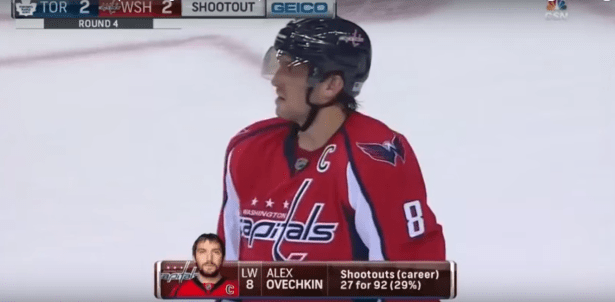
Why is Alex Ovechkin so bad in the shootout?

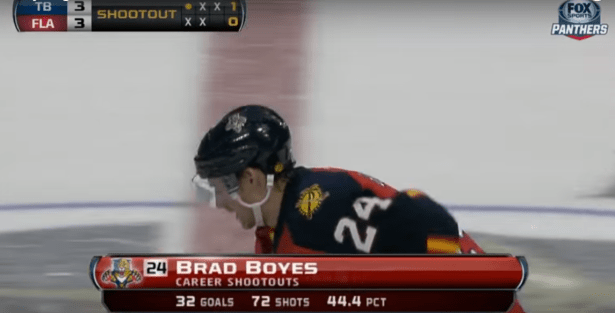
Why is Brad Boyes so good in the shootout?

Is there such as thing as the perfect shootout move? (the answer could be yes, so read on)

***

A while ago, Steve Ness took the time to watch every single NHL shootout attempt between 2012 and 2015, and came to some interesting findings.

By Ness’ count, 32% of shootout attempts are converted, which is interesting if we look at the following two screencaps:

ovie

boyes.png

Alex Ovechkin is one of the greatest goal scorers in the history of hockey. The Russian skates faster, shoots harder and has better stickhandling abilities than Boyes, so what gives?

Continue reading

Using Cluster Analysis To Identify Player Position

Embed from Getty Images

What did you think the first time you watched hockey? Did you know the difference between a forward and a defensive skater? Could you tell the difference just by watching? It’s likely that some outside factor (a friend, the play by play announcer, a graphic on the broadcast) alerted you to the fact that NHL teams use more than one type of skater.

But, say that outside variable never intervened, and you were left to your own devices. How long would it take for you to develop the idea of “forwards” and “defensive skaters”? Would you come up with your own classifications? Would you differentiate them at all?

Continue reading

Practical Concerns: Garret Sparks, Emotions & My New Favorite Hockey Movie

Garret Sparks of the Toronto Maple Leafs made history in his NHL debut after being drafted in the 7th round and working his way up from the ECHL. By all accounts, he did it on merit by maintaining a .924sv% since turning pro, including playing for .940 in the past two years in the minors.

He’s earned his big break, but in a way he is lucky to be playing for an organization which values performance and statistical trends as much as the Leafs. I’m not sure his story would have unfolded quite this way had he been born a couple of years earlier, or had he belonged to team which only tries out a young goalie if he’s over 6’5″. But we’ll get back to that.

Continue reading

Rebounds, Extended Zone Time, and the Quest For More Offense

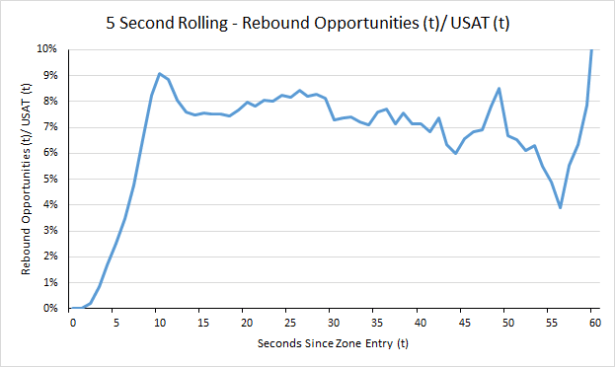
image (36)

Long has it been argued that sustained zone time is a reliable way to not only prevent your opponents from scoring but as a way to produce offense of your own. The argument that is often made, or at least the one that’s often heard, is that the longer you are in the offensive zone the more likely it is that the defense will become fatigued and make a mistake that leaves someone open for a prime scoring opportunity. 

So let’s test that theory by asking a more data driven question; does sustained zone time lead to an increase in shooting percentage?

Continue reading