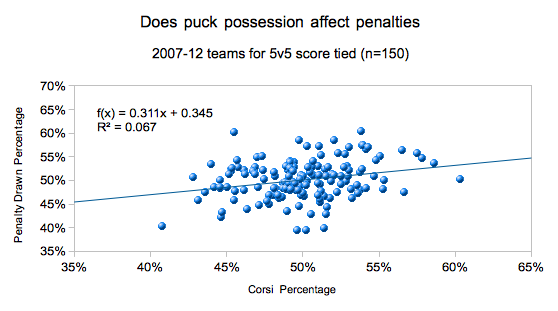
Friday Quick Graph: Does puck possession affect penalty differentials?

Screen shot 2014-10-30 at 11.55.42 AM

Using data from War-On-Ice.com, I grabbed the penalty and Corsi differentials for all teams for 5v5 score tied minutes. The whole point was to look at whether or not possession plays a role in a team’s penalty differential.

Above we see a weak but real relationship, with about 6.7% of penalty differentials being explained via possession.

From the regression curve, we estimate the average impact difference between a top and bottom possession team is about 11 penalties drawn per a season for 5v5 score-tied minutes. Of course, there is the opportunity to draw penalties for other team strengths and score situations. (The bottom/top difference is using the 40-60 rule)

Remembering Dellow: A few graphs to convince you on Corsi

From Wikipedia Commons

Over the past year, I based a lot of research off of  former work by Tyler Dellow. It is a bit funny because I actually never read any of Dellow’s work until well after I started writing about underlying metrics in hockey. I knew of him, but mostly was brought up on Gabriel Desjardins, Eric Tulsky, Ben Wendorf (yes, Hockey-Graphs’ own Wendorff), and a few others. It is also a bit difficult now because Dellow’s website has gone dark with his hiring, which removed the work I quoted or built upon.

One Dellow article that will be severely missed is Two Graphs and 480 words will convince you on Corsi.

Dellow presented analytical data in simple and effective ways. It made understanding of complex concepts -such as regression in goal differentials- easy.

Continue reading

Scoring talent influence on goal differentials and statistical double dipping

Screen shot 2014-09-09 at 1.20.24 AM

In August, I wrote an article on how you can translate Corsi differential values in terms of the average expected goal differential given for a players of similar average ice time.

In the article, I used an example of how this information could be used:

For example, Matt Halischuk and Eric Tangradi are two players who averaged 4th line minutes on the Winnipeg Jets. Tangradi finished the season with a 53.9% Corsi, while Halischuk was at 44.0%. Over the span of a season, forwards with those Corsi% would be expected to have on average of -1.04 and a -4.77 goal differential respectively. Therefore, on average, a 53.9% Corsi fourth line forward is worth 3.73 goals more than a 44.0% Corsi forward. Another option is comparing these players to the 46.8% Corsi% of an average fourth line player. The goal differentials can then be used to estimate win values using Pythagorean relationships.

There is a caveat with using raw Corsi% to estimate goal differentials; all effects -such as zone starts- still apply. The estimated goal differentials would be no more predictive than Corsi is; however, you can now easily and more accurately measure Corsi impact in terms of goals and wins.

Now, I used the example of Halischuk and Tangradi for a few reasons. The main one being that they are familiar to me as Winnipeg Jets players. They are two fourth line players that have experienced similar usage but have very polar opposite shot metrics. But, there is another reason… an interesting one.

Continue reading

An early look into some of the new numbers available

From Wikipedia Commons: A graph showing the minimum value of Pearson’s correlation coefficient that is significantly different from zero at the 0.05 level, for a given sample size.

There are two new and very exciting frontiers being explored by the hockey analytics blogosphere. There is the manual tracking of zonal statistics, such as zone entries and exits. This area of research was first pioneered by Eric Tulsky and Corey Sznajder. Then there is the splicing of Corsi into microstates, such as looking at shot attempt differentials momentarily after face off wins or loses in particular zones. The early workers on these numbers were Tyler Delow and Muneeb Alam.
(side note: it should not be a surprise that one of each group was recently picked up by a NHL team this summer)

I recently was able to get data from the non-NHL hires named above (and will enjoy their contact while I can until they are picked up too). Sznajder provided me with zone entry and exit data for just over 60% of the NHL. If you would like to check out his project and contribute, check this link. Alam sent over shot attempt events 10 seconds after a defensive zone face off, which was further separated into wins and losses.

I originally received this data for study of the Jets and noticed what appeared to the eye to be a relationship, and wished to delve in further.

Continue reading

Save Percentage vs the Experts: Do shots against inflate a goaltender’s save percentage?

Curtesy of Wikipedia Commons

I’ve seen many statistical articles look at different ways to determine whether or not shot volume inflates a goaltender’s save percentage; however, I’ve never been satisfied with the methods used, regardless of the outcomes. So, I finally went and looked at the data myself.

It’s been seven months since I’ve written anything on save percentage. With all that wait, you’d think I’d give you a big, long, and in-depth article… but I won’t. 

I had one planned, but accidentally lost all my data. Of course, errors always come in clumps. Instead of recovering the lost data, I ended up permanently removing it. To make matters worse, extraskater.com going black made the information a hassle to manually extract again. I probably could write a code (or get someone else) to draw up the information again… but I still have one piece remaining from the original data: the graph.

What is this graph of? What does it mean? Continue reading

Value of Corsi possession measured in goals

The average on-ice shooting and save percentages a player experiences tends to be influenced by their average time on ice per game. This relationship likely occurs due to a combination of factors: shooting talents of linemates and opponent, defensive talents of linemates and opponent, system and psychological effects, and an effect I like to call “streak effects”.
(See bottom for discussion on these effects)

Regardless of the reasons why, these effects indicate that not all Corsi percentages are created equal in impact. This has been discussed previously on Hockey-Graphs both here and here. So, can we measure this difference in impact? Continue reading

Is it time to appoint a new jester?

Toronto -with its high profile in the media combined with some questionable management- has consistently been the brunt of jokes over blogs, message boards and twitter from other fanbases.

Recently the Toronto Maple Leafs has made a bunch of savvy, low-risk, high-potential steps both in management and player personnel to improve their team. While they are still a distance away from being a contending team, the steps taken are not those that the online hockey community has grown to love about Toronto.

With this knowledge and the offseason nearly in our rearview mirror, it is time for Hockey-Graphs to ask its analytically inclined following:

All teams in poll came from an unofficial nomination survey I conducted on twitter.

Defensemen still have no substantial and sustainable control over save percentage

For quite some time there has been a debate going on: those who think you should add a defenseman’s effect on save percentage into player evaluations and those who think that adding such information causes more harm than good to the analysis. Note that this does not mean defensemen do not affect save percentage. That is an entirely different stance.

When it comes to evaluating a player statistically, you want the number to account for two things: effect and control. If a statistic does not help quantify how a player improves their team’s chance at winning, it is useless in measuring effect. If a statistic has too much white noise or other contributing factors that it would take too large of a sample to become significant to the player’s contribution, it is useless in measuring a player’s control over the effect.

Continue reading

How Do Teams Use Their Top Defensemen

The following is a guest article written by Rob Vollman of Hockey Abstract and Hockey Prospectus fame. Enjoy!

Other than the goalie, a team’s top defensemen are arguably the most important players on the teams. Great ones like Nicklas Lidstrom, Scott Niedermayer and Chris Pronger can completely alter the outcome of an entire season almost single-handedly. Who were the top pairing defensemen this year, how will they used, and how effective were their teams when they were on the ice?
Continue reading

Evaluating Defensemen using their effect on both team and opponent Corsi%

Courtesy of Wikimedia Commons

Eric Tulsky has previously shown that defensemen have very little control over their opponents on-ice shooting percentages, by demonstrating the extremely low repeatability in the statistic. Recently, Travis Yost expanded on this revolutionary information with showing that on-ice save percentage repeatability is even lower when reducing the impact of goaltender skill level differences; which makes sense when a defender with Ondrej Pavelec is going to have a higher probability of repeating a low save percentage, much like the opposite would be true with Tuukka Rask behind them. This leaves a defender’s influence on shot metrics as their primary impact in improving the team’s chance in winning the game. Tyler Dellow then pushed it one step further by stating the best method of evaluation then is using a defenseman’s impact on a team’s Corsi%.

But, there is one other primary factor: how a defender impacts the opposition. The two are not exactly one in the same, even though they are related:

Continue reading