Hockey Talk: Thoughts on Save Percentage and Shot Quality

(Image courtesy of Wikimedia)

Welcome to a brand-new, semi-regular segment where I -Garret Hohl- will touch on a few trending topics in hockey statistics in a less mathematical and more discussion format.

This week we will explore the debate on shot quality impacts on save percentage.

So let’s begin.

Continue reading

Friday Quick Graph: Player Career Charting by Percentage of Team Shots, 1967-68 to 2012-13

Embedding interactive graphs into blog posts, especially blogs with a narrow runner like ours, is frequently an awkward process. Just about the time things look good, you tinker with it and it looks bad. Nevertheless, I had a bunch of old data I put together, once upon a time, and I wanted to get it out there in a form that you could tinker with. Basically, in the past I have used the percentage of team shots in the games a player participated (%TSh; explanation here) as a way to capture a player’s contribution to the shot load; I also think it strongly implies a player’s involvement and contribution to team offense overall.

In the case of today’s graph, I took %TSh and looked at aging curves with a multitude of players from 1967-68 through 2012-13 (like I said, the data is a little old). I prepared this with a selected group of players available for the filter, the majority of whom are stronger, more familiar players of the years covered. I also included some players that struggled by the metric, for the sake of comparison. To filter, click on the “Name” bar, click on “Filter,” and let your imaginations run wild. Feel free to download if you wish.

Note: I believe I set the cut-off at 20 GP before I would record the point of data. It’s old. I’m old. We’re all getting older.

NHL Forwards vs. Defensemen Height & Weight, 1917-18 to 2014-15

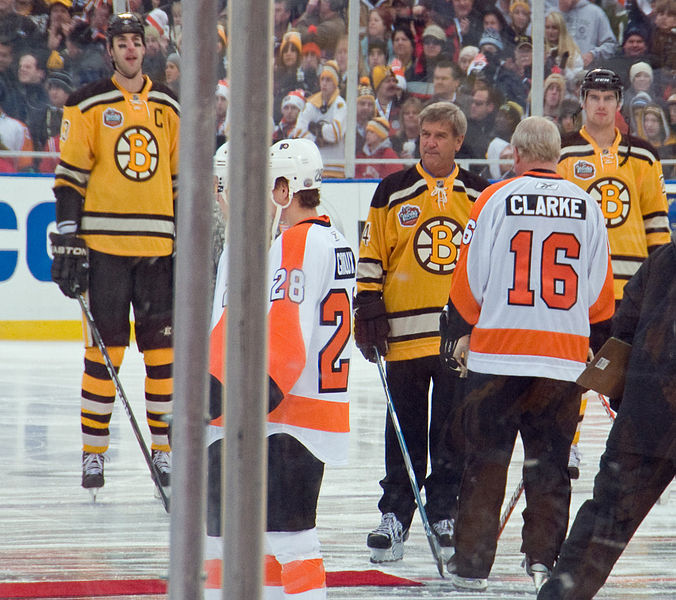
Photo by Eric Kilby, via Wikimedia Commons

Photo by Eric Kilby, via Wikimedia Commons

Building on my post from last week on overall skater height going back to 1917-18, I wanted to dig a little further into the the complexity of the data to see if there were any interesting takeaways. This included breaking the data into forward and defense data, to see if there was every any substantial increase in defenseman size or any other allusions to an attitude change in terms of size trends and preferences. While there are some slight differences, most interesting to me was, for as many changes as the NHL has undergone, there seems to be a uniform attitude about size when looking at forwards and defensemen.
Continue reading

The Goal Impact of Even Strength Faceoffs for NHL’s top 100 Faceoff Centres

Jackets-Canucks Face-off.JPG
Jackets-Canucks Face-off” by Leech44Own work. Licensed under CC BY-SA 3.0 via Wikimedia Commons.

A debate was ongoing on twitter over faceoffs and their value. The debate lead to most of this data being scraped anyways, so I thought I would display everything for your viewing pleasure.

The truth is, faceoffs tend to be highly overrated. They matter, but they do not matter on average much more than any other of the many puck battles that occur throughout the game. When you really break it down, faceoffs are really just a set play puck battle after all. However, some have more values than others.

Let’s take a look.

Continue reading

We are all human

Hey everyone.

A bit of a change of pace for Hockey-Graphs, here is a bit of an informal blog post. There are two separate things I want to address.

First thing:

I made a mistake.

Long ago on an article about Corsi and context, I made an error with moving the data from one spreadsheet into another. Everything in the specific article was actually correct. However, I had linked to a summarized data table on Google docs though that had some erroneous data on it.

The Google doc had summarized the average goal differentials for sets of players given their position in the depth charts and their Corsi%. What had happened is I accidentally copied 2nd line and 3rd line forwards in both their appropriate place and where 2nd and 3rd pair defenders should go. The online document has since been corrected and can be viewed here.

I made another mistake though in building an article off of that Google document. This article used the previous data in creating a quick model to estimate the goal impact difference between two players with differing Corsi percentages. The image has since been corrected.

I want to always be clear of my methods and my intentions, so this is why I wanted to post this to you.

Second thing:

Far smaller detail, the Hockey-Graphs podcast will be postponed until probably Friday. Rhys and I were not able to find a time convenient to both of us in order to record a session until then.

Sorry.
Until next time and thank you for reading and supporting our work.

NHL Player Size From 1917-18 to 2014-15: A Brief Look

Image by Erich Schutt, via Wikimedia Commons

Image by Erich Schutt, via Wikimedia Commons

As any person interested in hockey stats should do, I’ve been gradually building my own personal database of player information that I can use when Y3K robs my future post-human self of cloud data for 3 seconds. To that end, player size wasn’t a huge priority but I knew eventually I’d want to have it, if only to think about how normal-sized I’d be in the 1920s NHL. In the process of bringing in all that data, I decided to do a little demographic work on player height and weight. We all know the players are bigger now than they were before, but by how much? And is there greater variance in size now or in the past?
Continue reading