Friday Quick Graphs: Marginal Gains for Forwards

Screen Shot 2017-01-19 at 1.30.05 PM.png

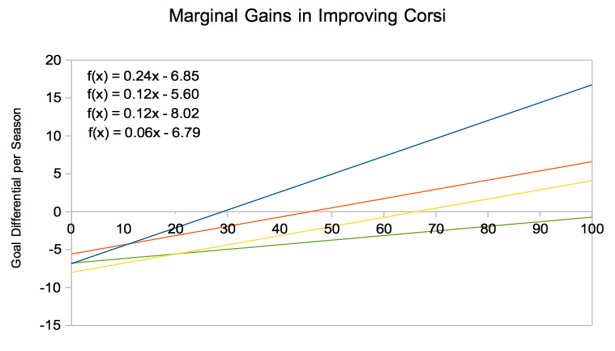
How many goals is improving a team’s first line worth versus your fourth line?

The above graph shows the number of goals over a season a team should expect in improving their player’s shot differential talent, here described in percentiles of talent.

The blue line is first liners with 2nd, 3rd, and 4th liners falling next with red, yellow, and green.

The blue line is the steepest, suggesting that moving from a 55th percentile player to 60th percentile player on the top line will improve a team’s goal differential by about twice that of a 2nd or 3rd line player. (This is not to be confused with improving from a 55% Corsi player to a 60% Corsi player)

What is interesting is that the marginal gains in improving a 2nd line player and 3rd line player is about equal.

The next question one should ask is: what are the costs in salary and cap hit for making said improvements?

Method:

  1. All forwards over all available full seasons were sorted by 5v5 TOI/GP
  2. Players binned into four groups of equal number of games played
  3. Each bin then sorted by Corsi%, and binned into percentiles
  4. Goal differentials are extrapolated to full season given average TOI per season for each line (so differing rates in injuries and pressbox banishment is being included)

Expected Primary Points are a better predictor of future scoring than Shots, Points

While I have spent a lot of time over the last several months digging into how we can quantify passages of play and inform better tactical decisions, it’s time to revisit how passing impacts scoring at the player level. We have only been using half of the picture in terms of individual shots and goals for player evaluation. Sure, we have primary and total points, but primary assists aren’t a very useful metric. The rate at which players create shot assists also appeared to have significantly more value than a player’s own shots in some analysis I did last year.

This piece will release individual passing data for the 2014 – 2015, 2015 – 2016, and 2016 – 2017 seasons, the latter of which tracked by Corey Sznajder, the former tracked by myself and many others. However, it is important to provide context and meaning to the numbers rather than simply inundate you with data.

Continue reading

Analyzing One-Timers: The Most Dangerous Shot in the Bag

Very little has been written about one-timers because, surprise, the NHL doesn’t track it. However, this is something we’ve been tracking for the last couple of seasons and it is worth a short post to investigate the value in this type of shot. Additionally, it is also worthwhile to dig into whether or not it is a skill to set up a one-timer for a teammate, or if it is strictly a shooter shoot. Lastly, is this type of shot more predictive than ordinary slap shots? Deflections? The standard wrist shot?

Continue reading

Eye on the Entry Draft: Which teams are set for future success?

Embed from Getty Images


In the salary cap era in the NHL, the entry draft has become a top priority for general managers. Acquiring players like Connor McDavid, Auston Matthews, Johnny Gaudreau, or Aaron Ekblad is most easily done at the draft table. More and more, GMs are recognizing that players peak at a young age, making long-term deals for early-20-somethings a wise investment, even if valuations are fueled by projection.

Here’s a sample of contracts for under-25-year-olds:

Continue reading

Coaching Analysis Part 2: Metropolitan Division

Note: This is Part 2 of the series on coaching analysis. Part 1 is here.

In this post, I’ll do a brief review of each team’s coach history from the current Metropolitan Division. These graphs only show a team’s performance in 5v5 situations from 2005 to 2016. The vertical lines indicate when a season begins. The horizontal line shows the 50% mark, where a team would be if it had as many shots for as shots against. The bold line is a smoothed representation of the team’s shot percentage. The faded bands around the bold line indicate 95% confidence intervals. These intervals show the uncertainty around the smoothed estimation of the data.

Continue reading

How good is Columbus? A Bayesian approach

Columbus has been surprisingly good this year. As of this writing, the Blue Jackets are first in the league in points and goal differential with games in hand. Remember: Columbus, in terms of preseason predictions, was pegged as more like a 5-8 finisher in the Metropolitan division (e.g. see here, here, here, here, and here).

That said, it’s still early. If it might take 70 games for skill to overtake randomness in terms of contribution to the standings, and if teams like the 2013-14 Avalanche and 2013 Maple Leafs (to name two prominent examples) can fool us for so many games, it doesn’t seem so unbelievable that a team could do it over just 32. (And the Blue Jackets aren’t the only example this year, either–Minnesota is under 48% possession and has a 103+ PDO right now.)

Continue reading

Applying CUSUM to hockey prediction models

This slideshow requires JavaScript.

The NHL season is a long and grueling affair and most teams will experience some ups and downs over the course of 82 games. Even a team that had a 67% chance of winning every game it played, would still have a 20% probability of putting up a five-game losing streak. And this is just straight probability theory with fixed probabilities. What happens when you consider all of the factors that go into determining the probability of winning an individual game, let alone predicting performance over an entire season?

Well, I’m not here to answer that question.

What I am here to do is to try to apply an analytical technique that was developed in the 1950s for the purposes of quality control in industrial and manufacturing processes to the game of hockey. Continue reading

25 Games In, What Does the Corsi Say?

Happy Max Corsi Productivity Day! We’ve reached the point in the season where Corsi best predicts future winning percentage. There’s plenty of more advanced ways to better predict how the rest of the season will go, but Corsi offers a simple baseline in a way that helps explain why it is so important.  I’ll first explain what that means and why it matters, then take a look at how we can use it to predict basic shifts in the standings for the rest of the NHL season.

Continue reading