Blue Jackets Coach Todd Richards’ Firing, & Why the History Doesn’t Agree With Mike Harrington

Photo by user

Photo by user “Arnold C,” via Wikimedia Commons; altered by author

The Columbus Blue Jackets made a bold move today, firing their coach of 3 1/2 seasons Todd Richards in favor of noted firebrand and Brandon Dubinsky fan John Tortorella. The move, riding the coattails of a 0-7 start for the Jackets, was done unusually early in the season, so unusually I decided to spill a little ink on it.

Around the same time I was rounding up the data, the esteemed (Buffalo Baseball Hall of Fame!) Sabres writer and analytics pot-shotter Mike Harrington decided now was the time to defend a decision that made little sense, about a team he doesn’t write about. It started with a reasonable tweet from Friend of the Blog Micah Blake McCurdy:

At which point Harrington followed:

Alright, Mike, let’s take a look at the “numbers that count,” according to you. There’s a fun history here.

Continue reading

Some Things to Know about One-Goal Games

Photo credit: Flickr user pointnshoot. Use of this image does not imply endorsement.

One of these teams will probably win by one goal.

Last season, as hockey analysts struggled to explain how a possession-dominant Kings team failed to make the playoffs while Anaheim and Vancouver topped 100 points, there was a lot of discussion surrounding the role of one-goal games in the standings. LA’s disappointing season was largely dismissed as bad luck, with an argument that went something like this: the outcome of a one-goal game is effectively random, and the Kings’ 13-9-15 record in these games (against the 33-1-7 and 22-4-5 performances of the Ducks and Canucks, respectively) was the difference in keeping them out of the postseason. I wasn’t entirely convinced by this, but it got me thinking about the randomness of close contests. How random are one-goal games, and how significant a problem is this for people trying to use numbers to understand why some teams win and others don’t?

Continue reading

NCAA Defencemen Graduation Rates and NHL Success

Northeastern UMass Hockey 8657.jpg
Northeastern UMass Hockey 8657” by SignalPADFlickr. Licensed under CC BY-SA 2.0 via Commons.

I’ve been playing with some NCAA prospect numbers lately and I had a hypothesis.

To set the stage, under the current CBA NHL teams have up to 30 days after a prospect leaves school to sign their drafted prospects to an NHL Entry Level Contract (ELC), or by August 15th after they’ve graduated.

What this means is that teams have an incentive to encourage players they think will become NHLers to sign as soon as possible. The trade-off with signing an NCAA player is the player loses their amateur eligibility and automatically has to move to another league. NCAA prospects typically move on to the AHL or NHL but it is not unheard of to see prospects take a side-step to the CHL in the odd circumstance.

Continue reading

Hockey-Graphs to take part of Vancouver Hockey Analytics Conference 2016

math

Image courtesy of picswallpaper.com

Two of Hockey Graphs contributors, Josh Weissbock and MoneyPuck, along with two Simon Fraser University professors, Tim Schwartz and Oliver Schulte, are organizing the first ever Vancouver Hockey Analytics Conference (#VanHAC).

This is not the first hockey analytics conference, as there have been a few popping up in recent years,  including those in AlbertaOttawa, Pittsburgh, Washington DC and Rochester.

Continue reading

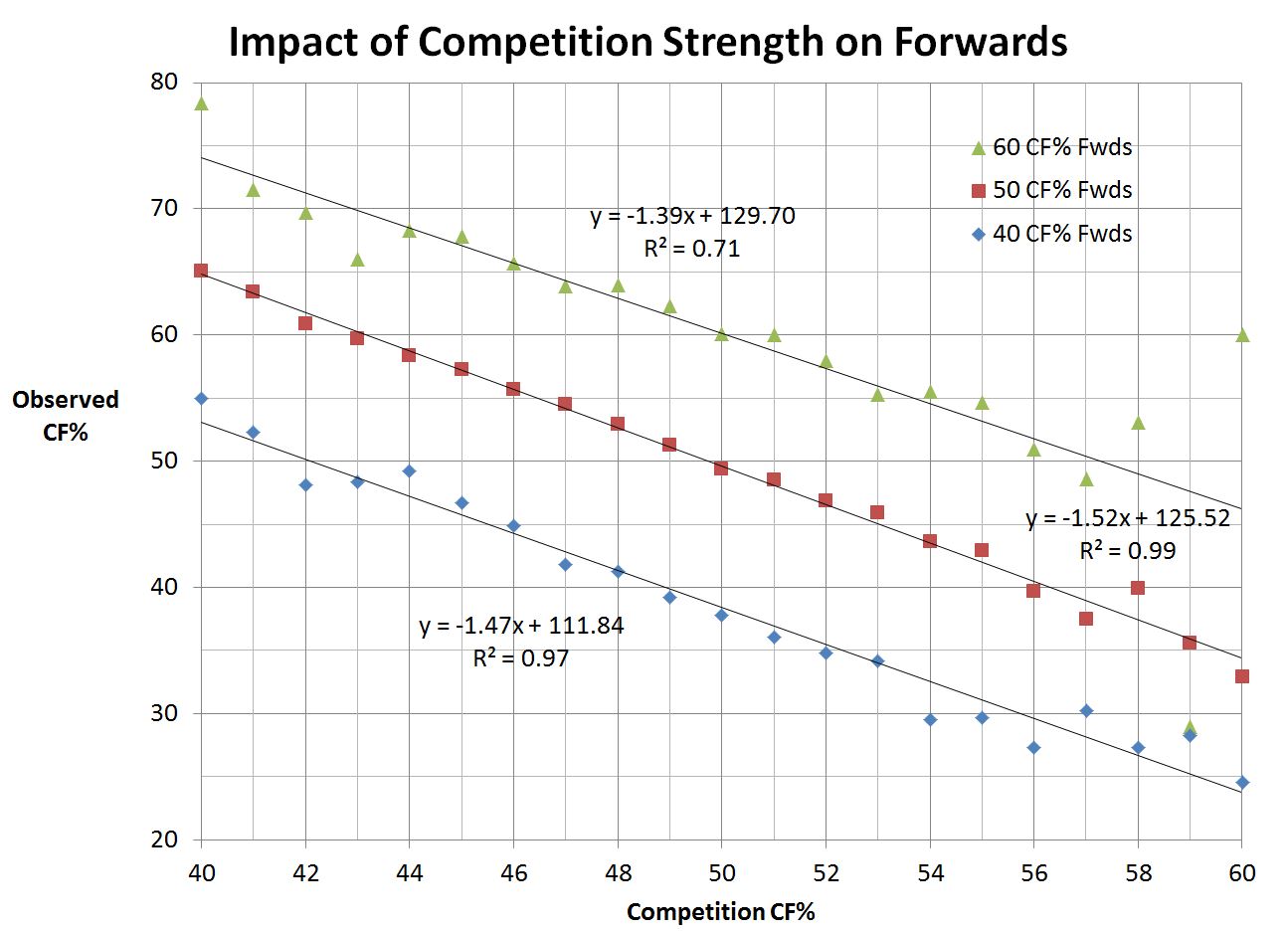
The relationship between competition and observed results is real and it’s spectacular

Raw Comp Impact

Abstract

There has been much work over the years looking at the impact of competition on player performance in the NHL. Prompted by Garret Hohl’s recent look at the topic, I wanted to look at little deeper at the obvious linear relationship between Quality of Competition and observed performance.

The results are a mathematical relationship between competition and observed, which could provide insight into player performance over short time frames. In the long run, the conclusions drawn by Eric Tulsky still hold. The impacts of facing normally distributed Quality of Competition (QoC) will wash out the effects over time. But this should not preclude consideration and even adjustments for QoC when looking at smaller sample sizes.

Continue reading

A New Way To Measure Deployment – Expected Faceoff Goal Differential

Zone starts are not that great of a metric. Although certain players do tend to be put out almost exclusively for offensive or defensive purposes, the reality is that for most players’ zone starts have a relatively small effect on a player’s performance. And yet, many hockey writers still frequently qualify a player’s performance based on observations like “they played sheltered minutes” or “they take the tough draws in the defensive zone”. Part of the problem is that we’ve never really developed a good way of quantifying a player’s deployment. With many current metrics, such as both traditional and true zone starts, it’s difficult to express their effect except in a relative sense (i.e. by comparing zone starts between players). So when a pundit says that a player had 48% of his on-ice faceoffs in the offensive zone, it’s difficult to communicate to most people what that really means.

Going beyond that, even if we know that 48% would make a player one of the most sheltered skaters in the league, the question that we should ask is so what? Simply knowing that a player played tough minutes doesn’t give us any information that’s useful to adjust a player’s observed results, which is really the reason that we care about zone starts. We know that if you start your shifts predominantly in the defensive zone, you’ll likely see worse results, but zone start percentages don’t tell us how much worse they should be. Traditional deployment metrics are too blunt of a tool – they provide a measurement, but not one that gives any context to the performance numbers that we really care about.

Continue reading

Practical Concerns: My analytics pot roast

Credit: Stuart West

Credit: Stuart West

Despite spending a lot of time at the rink watching hockey, most of my talents lie outside of the game. One of my favorite things in the world to do is to cook. And my favorite thing to make is pot roast – a big portion of the cheapest cut of meat from the butcher shop, cooked on low heat for seven hours in bottom-shelf red wine with some onions, carrots and a secret spice mix.

Making good food is a nifty ability to have on its own, but having more or less grown up in the kitchen, I can also appreciate how the process behind cooking has practical applications in sports. Ingredients, technique and (just as importantly) timing is everything when you’re cooking, and those three things matter just as much when you are trying to improve a hockey team.

Continue reading

Hockey Talk: Why the Kings were good at hitting a lot and also just good

Dustin Brown and the Stanley Cup.jpg
Dustin Brown and the Stanley Cup” by JulieAndSteveFlickr: Dustin Brown and the Stanley Cup!. Licensed under CC BY 2.0 via Commons.

Hockey Talk is a (not quite) weekly series where you will get to view the dialogue amongst a few of the Hockey-Graphs’ contributors on a particular subject, with some fun tangents.

This week we look at dump and chase systems and hitting:

Continue reading

#RITHAC Recap with Slides!

After a wildly successful Hockey Analytics Conference at the Rochester Institute of Technology, I wanted to say a few words of gratitude to everyone involved.

First off, this means a huge thank you to all that attended and viewed online. I really appreciate you taking the time out of your weekend to come listen to us all wax on about hockey analytics and things we spend hours laboring on. I feel I can speak for all the speakers when I say, it really does mean a lot to see that support and encouragement. So, thank you.

Next, to Matthew Hoffman and Paul Wenger, both professors at RIT. Matt was instrumental in paving the way to make this happen. Paul was a big hand helping out with the live stream and time-stamping the presentations so quickly after the conference ended. Huge thanks to both of them. Great guys and they deserve a ton of thanks for this event.

Continue reading