How good is Columbus? A Bayesian approach

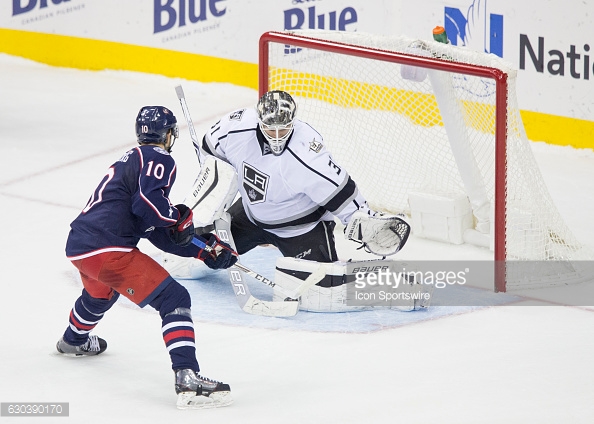
Columbus has been surprisingly good this year. As of this writing, the Blue Jackets are first in the league in points and goal differential with games in hand. Remember: Columbus, in terms of preseason predictions, was pegged as more like a 5-8 finisher in the Metropolitan division (e.g. see here, here, here, here, and here).

That said, it’s still early. If it might take 70 games for skill to overtake randomness in terms of contribution to the standings, and if teams like the 2013-14 Avalanche and 2013 Maple Leafs (to name two prominent examples) can fool us for so many games, it doesn’t seem so unbelievable that a team could do it over just 32. (And the Blue Jackets aren’t the only example this year, either–Minnesota is under 48% possession and has a 103+ PDO right now.)
Continue reading

Predicting Shot Differentials for NCAA Players

While there has been an increase in the type of data that’s available to us on prospects, we are still lacking across all developmental leagues. More importantly, and this is particularly true for the NCAA, player-level data still eludes us, even when there is team-level data present. To get at the context with which a player performs and the factors governing his or her environment, we are left with estimates of things like ice time and quality of competition/teammates.

While this hasn’t stopped us from making advances to enhance traditional scouting and prospect analysis, having player-level shot metrics would be a wonderful piece of data to have when evaluating their performance. This article will look at a method to predict those numbers.

Special thanks to DTMAboutHeart and Matt Cane for their feedback and guidance at certain steps in this process.

Continue reading

#1MinuteTactics – Studying The World Cup Of Hockey

When you bring the best players and coaches together, entertaining things happen. Not only that, but many of the tactical habits employed by elite hockey team are actually not so hard to grasp.

Here are five teaching points brought to us by The World Cup Of Hockey 2016, broken down and served up in just over one minute apiece:

1) Transition Play: Team North America’s Neutral Zone Mastery

Continue reading

#RITHAC Slides, Video, & Recap

On Saturday, September 10th, the 2nd Hockey Analytics Conference at the Rochester Institute of Technology was held. It was a huge success and this post has the slides for each presenter, as well as video for most of the day. We had some technical problems early on, but most of the event was recorded. There is also footage of the #RITHAC Cup that was held immediately following the conference (stick tap to Conor Tompkins for Periscoping the event).

Continue reading

Why Deterrents Are Irrelevant

Hits. Long-forgotten when it comes to hockey analytics and for good reason. It’s been established in many places, even on this site by Garret Hohl, that how often you hit your opponent carries little worth when it comes to predicting goals. Sure, there will always be a play here or there that works out, but by and large hits are noise. Yet, that doesn’t stop teams from shelling out big money for players that can score and hit, despite all evidence to the contrary that the latter is noise. So, why bring it up? Well, someone retweeted this into my timeline Wednesday night and I couldn’t get it out of my head.

Continue reading

The Distribution of QoC/QoT at the NCAA Level

It is accepted that measures of Quality of Competition and Teammates have varying effects at the NHL level. Over time, the distribution of a player’s QoC will mirror that of many others. His QoT is another matter. This is nothing new and has been looked at on this site here by petbugs, here by Garret, and here by Dom.

However, where these measures likely have greater impact is at the Junior, European, and NCAA levels where the disparity in talent between the best and worst teams is greater than at the NHL level. In this article, I’m going to clearly show  just that, and articulate why this is important when evaluating prospects as it adds significant context to their performance.

Continue reading

Quick Post: Do Past Sv% Variables Predict Future Sv% Variables?

Embed from Getty Images

The usefulness of on-ice save percentage (and derivative metrics such as Sv% Rel and Sv% RelTM) has been the source of many, many heated debates in the analytics blogosphere. While many analysts point to the lack of year-over-year repeatability that these metrics tend to show (past performance doesn’t predict future performance very well) as evidence of their limitations, others (primarily David Johnson of HockeyAnalysis.com) have argued that there are structural factors that haven’t been accounted for in past analyses that artificially deflate the year-to-year correlations that we see.

David’s point is a fair one – a lot can change about how a player is used between two samples, it’s not unreasonable to think that those changes could impact the results a player records. But we don’t just have to speculate about the impact those factors have – we can test the impact, by building a model that includes measures of how these factors have changed and seeing how it changes our predictions.

Continue reading

10 Rules Of Thumb For Hockey Analysts

Embed from Getty Images

  1. The point of hockey is to create goal differential. The point of hockey analysis is to find ways to improve it.

  2. Shot differentials today is goal differentials tomorrow.

  3. 100-10-1. 100 minutes of your time to create data, 10 minutes of the coach’s time to digest the data, 1 minute of the player’s time to absorb the data.

  4. Optimise workload, reduce uncertainty.

  5. If your findings are either always or never surprising, then review your methodology. 80/20 (in favor of confirming existing beliefs) is a good place to start.

  6. Your priority is to help the coach get a better night’s sleep and to help players maximise their experience.

  7. Know your place, but stand your ground.

  8. We are all on the same team.

  9. Who you compete against influences your results; who you work with dictates your destiny.

  10. The job is only done when you’ve trained someone to make you expendable.


Jack Han is the Video & Analytics Coordinator for the McGill Martlet Hockey team (not his full-time job). He also writes occasionally about the NHL for Habs Eyes on the Prize. You can find him on Twitter or on the ice at McConnell Arena.