Expected Goals Data Release

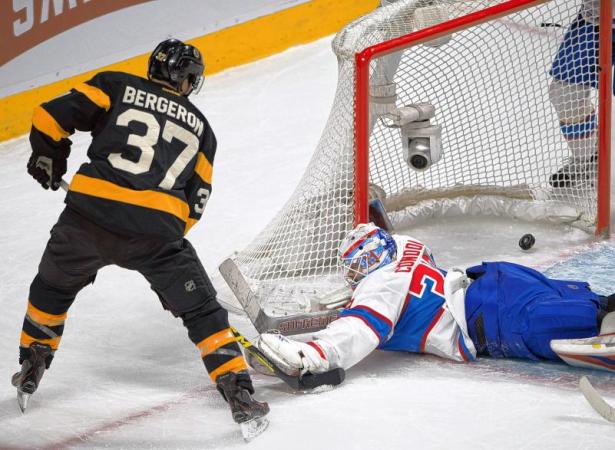
bergy goalBack in October 2015,  @asmae_t and I first unveiled an Expected Goals model which proved to be a better predictor of team and player goalscoring performance than any other public model to date. Thanks to the feedback of the community, a few adjustments and corrections were made since then. The changes were the following:

  1. Score state was a variable that was accounted for in the model but was not explicitly mentioned in the original write-up. Recall that after accounting for all variables, including score state, it was found that a shot attempted by a trailing team still has a lower likelihood of resulting in a goal than a shot taken by a leading team.
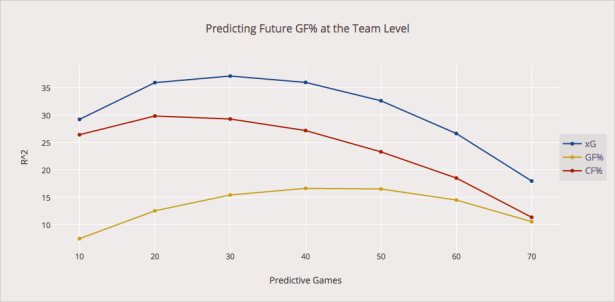
  2. The shot multiplier in Part I of the original write-up was adjusted using a historical weighted average instead of in-season data. Thus, a 2016 shot multiplier for example would be based on the average of the regressed goals (rGoals) and regressed shots (rShots) of 2014 and 2015.  This adjustment improved the model’s performance against score-adjusted Corsi and goals % in predicting future scoring, as seen in the graph below. We thank @Cane_Matt again for pointing out this error. Corrected Version of xG

Continue reading

Special Teams Analytics in the 21st Century

BestPPPredPlot1

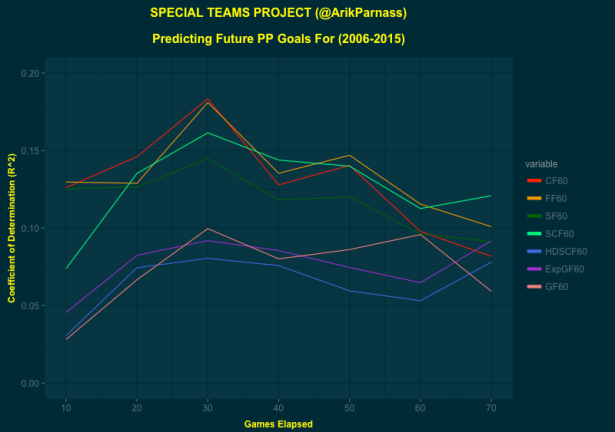
Despite them accounting for approximately 20 percent of NHL game time, special teams have been largely ignored when it comes to analytics. Considering the data available and its small sample size compared to even-strength, that is somewhat understandable, and there have certainly been attempts to properly quantify and assess power plays. So what do we know so far? Continue reading

Predicting Which Players Will Succeed on the Powerplay

Embed from Getty Images

Alexander Semin did not have a good season last year. After producing decent numbers in his first two seasons in Carolina, with 35 goals and 51 assists in 109 games, Semin struggled in 2014-2015, putting up only 19 points over 57 games and seeing his shooting percentage drop below 10% for only the second time in his 10 year career. With three years remaining on a contract paying $7MM per season, the Hurricanes decided to cut their losses, buying out the Russian winger prior to the start of the UFA period in July.

While at first glance Semin’s release seems like a reasonable response for a former top scorer who appeared to have lost the magic touch, if we look at little closer at Semin’s numbers a different story beings to emerge. Semin logged only 1.5 minutes of powerplay time per game in 2014-2015, down more than 2 minutes from his 2013-2014 total, and well below the 4+ minutes he would see at the start of his career in Washington. While other factors certainly played a role in his fall from grace (a 97.5 PDO at 5-on-5 doesn’t help), there’s no denying that the coaching staff’s decision to keep Semin off the ice when the ‘Canes were up a man cost him (and likely the team) points.

Although Semin is an extreme case, the general story of a player losing points as his powerplay time decreases is not uncommon amongst NHLers, and illustrates that opportunity often matters just as much as ability when it comes to a player’s results. Each team’s powerplay minutes are limited, and valuable to both the team and player, given the higher scoring environment that exists when a team is up a skater. Overall, teams scored roughly 25% of their goals on the powerplay last year, despite the fact that less than 20% of total ice time was played with a team on the man-advantage.

Continue reading

Hockey Talk: Shot Quality

Embed from Getty Images

Hockey Talk is a (not quite) weekly series where you will get to view the dialogue among a few Hockey-Graphs contributors on a particular subject, with some fun tangents.

This week we started from a Twitter conversation suggesting that expected goals calculations (xG) might underweight “shot quality”. A topic that HG contributors are hardly short of opinions on. Continue reading

Practical Concerns: Meatballs & The Art Of Deployment

dep

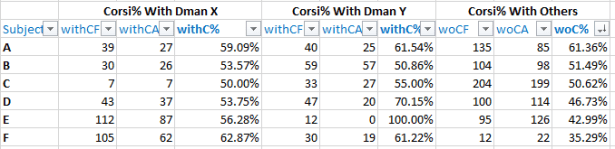
Last week, I dug up some old stats and posed this question to our Twitter followers and to a few people I know working in pro hockey.

Some interesting lessons were learned.

Information Underload

Marc Bergevin once said that it is difficult for fans to fully understand the decision-making process of NHL general managers and coaches because they don’t have access to all the information.

Most people I’ve talked to with at least a working knowledge of analytics were able to give very sensible suggestions on which three defense pairings to form given the available players, despite having no idea of who these players are and with only their 5vs5 With or Without You possession stats at their disposal.

Continue reading

A Guide to Neutral Zone Tracking Part 2 of 2: How to track the Neutral Zone

A carry-in just waiting to be recorded by someone.

Okay so in our last post, we discussed why tracking the Neutral Zone is important.  We also briefly discussed what we track when tracking the neutral zone.  But in this post, I’m going to provide you with a detailed guide and the resources you will need to actually track the neutral zone yourself.

What You Need For Neutral Zone Tracking:

Neutral Zone tracking doesn’t require much.  At a minimum you only require:
1.  Access to NHL Games
2. Something to record Neutral Zone Entry #s (Usually a spreadsheet)
3. A place to compile your total #s (Usually another spreadsheet)

Continue reading

A Guide to Neutral Zone Tracking Part 1 of 2: Why Neutral Zone Statistics Matter

nielsen

Frans Nielsen is incredibly good in the neutral zone.  But How important is that really?  And how can we tell that’s the case to begin with?

A while back, Hockey-Graph’s own Matt Cane wrote the following tweet:

Matt was referring to a statistic commonly found in “Neutral Zone Tracking,” which purports to measure the quality of individual and team play in the Neutral Zone.  Neutral Zone Tracking was pioneered by a bunch of guys at Broad Street Hockey (Eric Tulsky and Geoff Detweilier) back in 2011 and in the years since, a bunch of individuals have also began to do the same.  The work that’s been done on this area, on other sites as well as on this one suggests neutral zone tracking results in some extremely important data that we should be very interested in.

What is Neutral Zone Tracking:

Continue reading