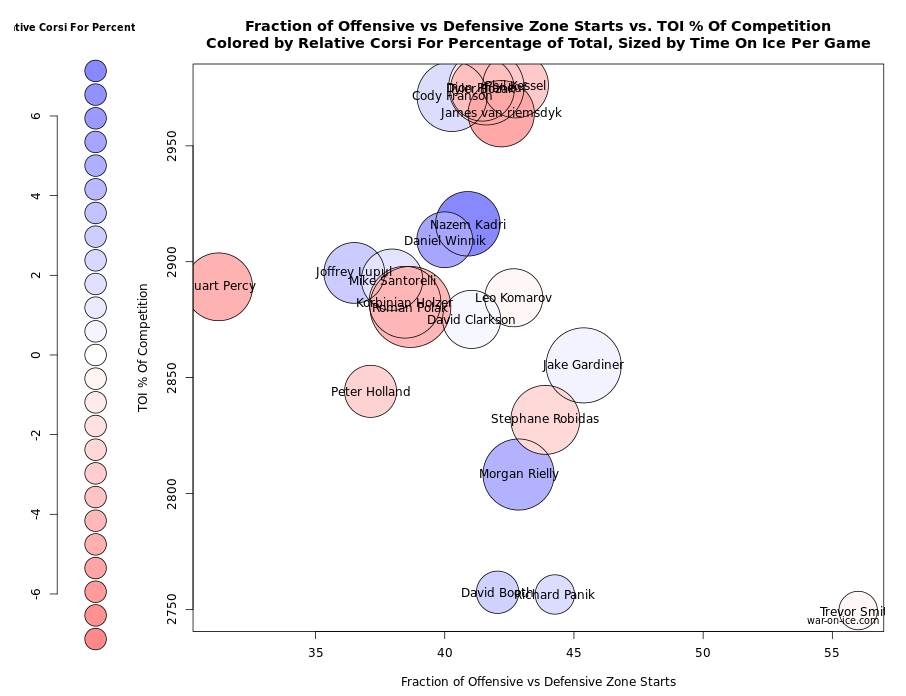
The relationship between Corsi% and winning faceoffs.

Faceoffs have always been an interesting area of research. There have always been individuals in the media and public who extol faceoffs importance; I have even heard quotes like: puck possession is so important and you cannot win the puck possession battle if you are starting without the puck.

Not too long ago Gabriel Desjardins showed that the impact of a faceoff is real (as one would expect) but likely over glorified by some. One example from his study showed shot rates after an offensive zone faceoff:

From these numbers Desjardin estimated an impact of +2.45 goals for every 100 non-neutral zone faceoff wins over 50%, and +3.66 for every 100 for special teams. A real impact, but not overly huge impact. Neutral zone faceoffs carried even less of an impact with +0.90 goals for every 100 faceoffs over 50%.

But what about faceoffs overall relationship with possession? Continue reading
The Hockey Graphs Podcast: Episode 1

qe7ScKvj

Welcome to the inaugural episode of the Hockey Graphs podcast, where Rhys Jessop (of Canucks Army and That’s Offside) and Garret Hohl navigate the wonderful world of podcasting for the first time ever. Join us as we discuss Vancouver Canucks and Winnipeg Jets prospects, what the hell is up with the Anaheim Ducks, and, of course, a healthy dose of fancystats. Continue reading

One of the many issues with the Toronto Maple Leafs

Screen shot 2015-01-08 at 10.32.59 AM

Rand Carlyle was recently fired from the Toronto Maple Leafs. This brought joy to many online Leaf fans as many –legitimately– believed Carlyle to be a source of the Maple Leafs consistently being out shot, out possessed, and out chanced.

Of course, Carlyle was not the difference between the Leafs spontaneously becoming a contender in the east. There are issues with the Maple Leafs that will take some time for Brendan Shanahan and company to fix. Continue reading

Back to Basics: Forward Univariate Analysis

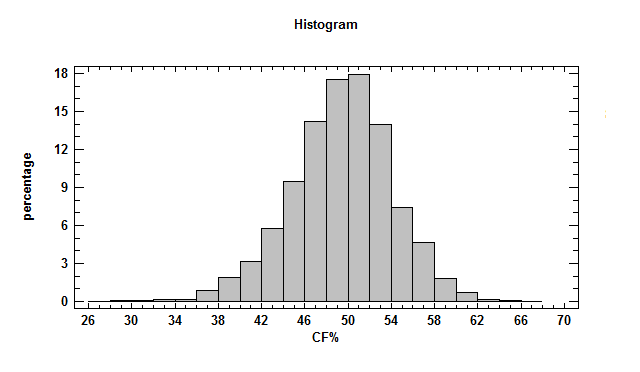
Uni - CF%2League wide univariate analysis isn’t very sexy, which is why you rarely see it used in the hockey blogosphere. Still, the information is necessary in better understanding what we are describing and adding context. It is also useful for looking back at whenever a variable may not impact or work in a model as you initially hypothesize.

I gathered all player season data for each full (excluding lockout) season available in the “Behind the Net era”, filtering only forwards with 100 or more minutes. These seasons were combined into one massive sample of 2368 player seasons. Continue reading

Goaltender Performance vs Rest

Photo by Michael Miller, via Wikimedia Commons

Photo by Michael Miller, via Wikimedia Commons

I couldn’t find this data (if it’s out there, please point me to it), so I went back to 1987 and pulled goaltender performance vs games rest. We knew goalies did poorly in the second game of a back-to-back pair, but I’m surprised to see such a large gap for two and three games. (The overall dataset is roughly 40000 games.)

Days between Games % of Games Mins (G1) Mins (G2) Shots Vs (G1) Shots Vs (G2) Sv% (G1) Sv% (G2) W% (G1) W% (G2)
1 9.5 54.7 55.0 28.9 29.7 0.905 0.897 0.498 0.421
2 35.6 57.0 56.8 28.7 28.7 0.908 0.901 0.522 0.486
3 19.2 57.1 56.7 29.0 29.0 0.905 0.900 0.514 0.481
4 12.1 56.7 56.3 29.2 28.7 0.899 0.898 0.477 0.487
5 7.2 55.4 55.2 29.0 28.8 0.892 0.899 0.440 0.448

There are lots of systematic issues here (e.g. most back-to-back games are on the road) but simplistically, this would mean goalie rest obscures the bulk of a goaltender’s value. That seems implausible and worth looking at in more detail…

Schedule Adjustment for Counting Stats

Edit:There is another version of this article available in pdf which includes more explicit mathematical formulas and an example worked in gruesome detail.

Rationale

We all know that some games are easier to play than others, and we all make adjustments in our head and in our arguments that make reference to these ideas. Three points out of a possible six on that Californian road-trip are good, considering how good those teams are; putting up 51% possession numbers against Buffalo or Toronto or Ottawa or Colorado just isn’t that impressive considering how those teams normally drive play, or, err, don’t.

These conversations only intensify as the playoffs roll around — really, how good are the Penguins, who put up big numbers in the “obviously” weaker East, compared to Chicago, who are routinely near the top of the “much harder” western conference? How can we compare Pacific teams, of which all save Calgary have respectable possession numbers, with Atlantic teams, who play lots of games against the two weak Ontario teams and the extremely weak Sabres? Continue reading

The Defensive Shell is a good idea in theory. Unfortunately, it doesn’t work.

The results of score effects are pretty basic hockey analytics knowledge at this point.  Teams down in goals tend to take more shots, while teams up tend to take less, with the effect becoming larger as the game goes on.

We often explain this effect by saying teams go into a “defensive shell”, playing extremely conservative on offense to avoid easy opponent scoring opportunities, at the cost of more time in the team’s defensive zone.  It is of course, not a one team effect either – we often emphasize that the other team is taking greater risks as well to try and score, which is why the shots taken by the team with the lead go in at a higher rate than normal.    That said, it’s pretty much accepted that going into a shell would be a losing strategy for a team to attempt over a whole game, which is why teams don’t attempt this strategy for a full game. Continue reading

Draft & Develop: How analytics can be combined with qualitative scouting

NHLe1

The graph above represents how some may look at and use hockey statistics; the better a player performs in a statistic equates to more skill. This practice can be found in league equivalencies -now more commonly known as NHL equivalencies (or NHLe)- originally contrived here by Gabriel Desjardins.

In truth, almost all of us can be guilty of this at one point or another, like when using evidence like “Player A has a better Corsi%; therefore, he is pushes the play better”. Most reasonably understand that this is not how it works, but it is not discussed often enough. These tools are used to show average expected outcomes. The output is not the only possible outcome.  Continue reading

Adjusted Possession Measures

A little while ago I wrote an article at SensStats discussing score effects and suggesting a new formula which we might use to compute score-adjusted Fenwick. This article addresses several interesting questions and new avenues that were suggested to me by various commenters.

  1. The method in the above-linked article simultaneously adjusts for score and for venue (that is, home vs away). It’s interesting to estimate the relative importance of these two factors. As we’ll see, it turns out that adjusting for score effects is dramatically more important than adjusting for venue effects.
  2. We might consider adjusted corsi instead of adjusted fenwick; it turns out that adjusted corsi is a better predictor of future success than adjusted fenwick at all sample sizes.
  3. Most interestingly, we might consider how score effects vary over time, and see if we can create a score-adjusted possession measure that takes this variation into account. We find here that performing such adjustments is indistinguishable in predictivity from the naive score-adjustments already considered.

Several people have pointed out that score effects have a strong time-dependence. At least as far back as 2011, Gabriel Desjardins (@behindthenet) noted the effect and readers with keener memories than me will no doubt remember still earlier examples. Just last week, Fangda Li (@fangdali1) wrote an article arguing that score effects play virtually no role outside of the third period. This article will show that, while score effects are magnified as the game wears on, time-adjustment for possession calculations is not justified. Continue reading

The State of Save Percentage

Image from Wikimedia commons

Currently save percentage is the single best statistic for evaluating goaltenders… which is unfortunate as save percentage is extremely rudimentary and a suboptimal statistic.

There are two important factors for a statistic to be useful: that it impacts wins and the individual can either control or push the needle. Save percentage has both. Continue reading