Preparing and organizing game footage is one of my main responsibilities working for the McGill Martlet hockey team, and has become something that I enjoy quite a bit over the course of the past two seasons. Having played for coaches who use video analysis to various degrees in both hockey and tennis growing up, I think seeing one’s self play sports on video is the best way to correct deficiencies and identify areas for growth.
Practical Concerns
Practical Concerns: Fixed vs. growth mindsets in hockey analytics
The vast majority of scientific research has indicated that people with growth mindsets tend to be higher-achieving than those with fixed mindsets. Growth-oriented people are the ones who are more interested in furthering their education, or picking up a new hobby, or getting out of their comfort zones to experience new things.
Why I’m Supporting Micah Blake McCurdy’s Work at Hockey Viz
5v5 shots, Senators +3% at Jets. pic.twitter.com/xemFFKZ6e1
— Micah Blake McCurdy (@IneffectiveMath) September 30, 2015
//platform.twitter.com/widgets.js
A couple days ago, Micah Blake McCurdy made his first step towards The Great Unknown. It’s a decision hanging on a number of questions we always ask ourselves in the analytics community: What is my work worth to me? What is my work worth to others? For as much time as my spend on it, how can I make sure my work means something, and my time rewarded? How do I make sure my work stays exactly that: mine?
For the past decade, a number of powerful minds have navigated The Great Unknown, finding that apprehensive teams were only willing to commit peanuts and, on rare occasions, real salaried work after a partnership of a couple years. What made The Great Unknown even more of a mystery was the disappearance of sites, and data, and “stats” groups peddling other people’s work (usually in poor or incorrect fashion), and the discovery by some stats analysts that teams had been tracking data in ways that were curious, tedious, unhelpful. When the so-called Summer of Analytics occurred, The Great Unknown had the curtain pulled back a little bit: we started knowing who was getting hired where. But that peek exposed the still-immense uncertainty of the work available with some teams, and opened a new area of intrigue: analytics writing.
So why is what Micah is doing so important?
Practice Concerns: Coaching wisdom & redefining consistency
Should all players be treated the same? Probably not.
A very experienced NHL coach once said something to the effect of:
“The most difficult players to coach are those in the middle of your lineup. Your best players will always be your best, and your depth players are usually just happy to be there. Catering to the second and third liners is the toughest thing, because they’ll often have a different opinion of themselves than you.”
When I first heard this, I thought it made a lot of sense from a psychological point of view. In every team I’ve been a part of, there were three groups of players: those who were on the powerplay, those who wanted to get on the powerplay, and those who know they’ll never be on the powerplay. Usually the second group experiences the most friction with the coaching staff, and I am speaking from personal experience.
Prospect Cohort Success – Evaluation of Results
“2008 NHL Entry Draft Stage” by Alexander Laney. Licensed under CC BY-SA 3.0 via Commons.
Identifying future NHLers is critical to building a successful NHL team. However, with a global talent pool that spans dozens of leagues worldwide, drafting is also one of the most challenging aspects of managing an NHL team. In the past, teams have relied heavily on their scouts, hoping to eek out a competitive advantaging by employing those who can see what other scouts miss. Quite a challenge for many scouts that may only be able to watch a prospect a handful of times in a season. While there has been some progress in the past few years with teams incorporating data into their overall decision making, from the outside, the incorporation of data driven decision making in prospect evaluation has been minimal.
To address this, Josh Weissbock and myself have developed a tool for evaluating prospect potential which we call Prospect Cohort Success (PCS), with the help of others in the analytics community including Hockey Graphs Supreme Leader, Garret Hohl.
Practical Concerns: Why Alfy should do analytics
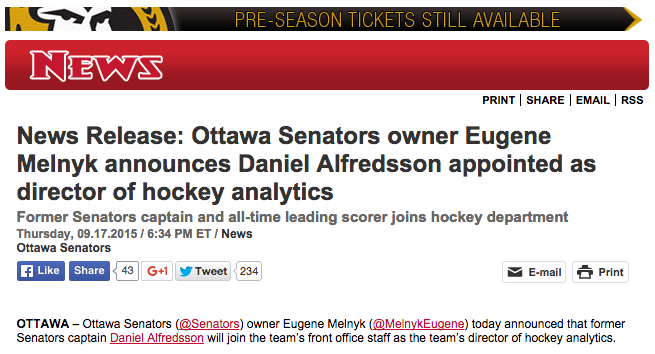
Yesterday, the Ottawa Senators announced the hiring of Daniel Alfredsson as the team’s Senior Advisor to Hockey Operations. Alumni of the Hockey-Graphs blog Emmanuel Perry (who is a Senators fan) took advantage of the situation to come up with this (obvious hoax): https://twitter.com/MannyElk/status/644648872682242048
Now, the more I think about it, the more I believe that having someone like Daniel Alfredsson lead an NHL analytics group is actually a wonderful idea.
Practical Concerns: Why analytics is politics (and what you should know if an NHL team ever comes calling)
Yesterday, I had a nice chat with a member of the hockey media whom I respect a great deal for his habit of “seeking truth from facts” despite often sitting on panels where his co-hosts did not share the same attitude. He reached out to me with questions regarding something I previously published on Hockey-Graphs, and we spent about 20 minutes exchanging information – something I enjoy doing anytime with people who like to think the game.
At one point, his line of questioning turned to the specifics of the work I was doing, some of which I wasn’t really keen on discussing. So I told him:
“Look, what I do for our staff is pretty simple. I do things either to save time, or to reduce guesswork. That’s all there is to it.”
Practical Concerns: Supercharging the Eye Test with Microstats
Analytically-minded hockey people, as a group, tend to dismiss the eye test as biased. There is, of course, some truth in that position. “What you see is not all there is.”
However, I think it would be misguided to look at traditional viewing-based scouting and saying that it just doesn’t work. We shouldn’t forget what makes a human being different – and, in some ways, better – than a machine.
There is no camera as versatile as the human eye, and there is no computer as sophisticated as the human brain. So instead of disempowering those tools, why not try to make them better?
Let’s go back to high school for a second.
Sunday Notes: September 13, 2015
“Math lecture at TKK” by Tungsten – photo taken by Tungsten. Licensed under Public Domain via Commons.
Welcome to Sunday Notes, where we try to rehash important developments occurring on Hockey Graphs and elsewhere in the CORSI twitter league in less than 500 words. I’m sorry if we forgot about your post, or misconstrued what you said. We don’t care. Don’t @ us. Just do better next time. – Asmaen
Practical Concerns: How To Replace Superstar Goal-Scoring
Earlier this week, I read an interesting story by Frank Seravalli on TSN.ca on Mike Babcock, Phil Kessel and the Toronto Maple Leafs, which is a good read for anything interested in how coaches think. For me, it also illustrate another way analytics could be employed to make a coach’s life a lot easier and take out some of the guesswork inherent in the job.
It was not too surprising to hear that Babcock was already thinking about how to get the most out of his team this season while on vacation, but I am very curious about his thought process behind how best to replace Phil Kessel. But before we start thinking about how to replace Phil Kessel (or his production in aggregate), we need to start thinking about how we are to measure a Phil Kessel’s offensive contribution.