Toronto Maple Leafs Passing Metrics 101

Embed from Getty Images

<p style=”margin:0;”></p></div>

Nazem Kadri has been the name on the tongues of most Toronto Maple Leafs fans for many reasons. It could be due to his slow start, where at the time of this writing he currently ranks 324th of forwards in points per sixty minutes. However, thanks to the words of Mike Babcock, Kadri’s efforts have not gone unnoticed. In fact, Babcock is quoted as saying, in reference to Kadri, “He is in on all the chances, he generates a ton.” After Babock’s words and this piece on Kadri and his chances, it’s apparent the goals will come and his slump is simply a natural byproduct of this chaotic sport.

Well, in addition to some of our newer data and metrics, let’s take a look at how and where Kadri generates chances for his teammates, shall we? All data is 5v5 unless otherwise specified, and is through games completed as of 12/4.
Continue reading

The 2015 OHL Final Part Three: Erie Otters and Oshawa Generals Passing Data

The last two pieces of mine focused on passing network analysis for both the Erie Otters and Oshawa Generals from their 2015 OHL Final. The point of this short series was to look at how and why teams are successful over a playoff series. Generally, five-game samples aren’t large enough to give much credence to, and yet a sound game plan and tactical preparation can influence an upcoming playoff series. With the type of data collected and analyzed through passing networks, it provides a baseline of how influential the Otters and Generals players were in their series. From there, naturally, any good analyst will go to the video to find evidence of how these numbers occurred, to augment their conclusions. These first two series served as a opportunity to present new ways of analysis with our data this season, something that, come playoff time, will be given a test run in terms of series predictions.

This final piece in this series will focus on the production for each player and team in a more traditional sense. What does that mean? Lots of numbers and charts. For starters, Erie generated far more passing offense in this series than Oshawa. At 5v5, here were the Otters possession numbers for shot sequences from single, multiple, and scoring chance passes.

Continue reading

The 2015 OHL Final: Oshawa Generals Passing Network

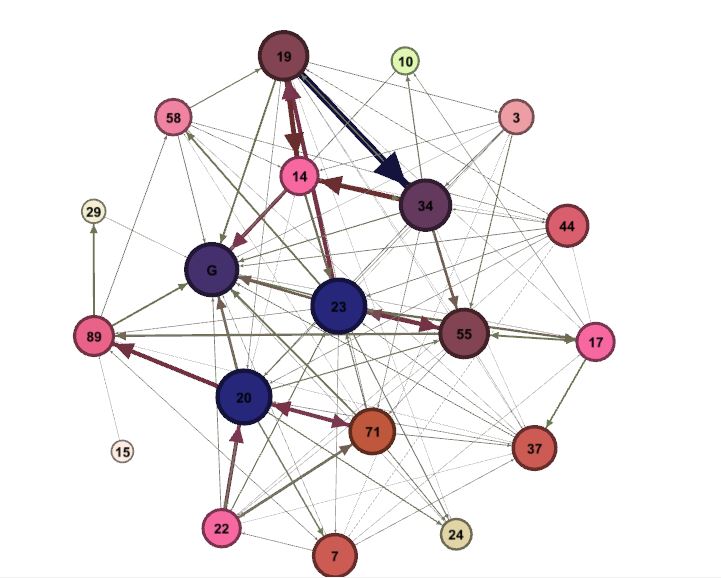
Last time, I took a look at the passing network for the Erie Otters during the 2015 OHL Final. Today, we’ll take a look at the passing network for the Oshawa Generals. Below you’ll see their network constructed using Gephi.

Oshawa_Network

Another reminder on how to read the visual: The larger and darker the node (player), the higher number of edges (connections or passes) to another player or goal (shots) that player had. Rather than simply total up the passes and shots, I’ve assigned weights based on whether that pass led to an actual shot on goal, was a scoring chance, was a danger zone pass (from behind the end line or across the Royal Road), resulted in a goal, etc. The edges (lines) between players are weighted as well, so you can tell which players were setting up a higher number of chances for specific shooters.

Continue reading

The 2015 OHL Final Part One: Erie Otters Passing Network

At the Rochester Hockey Analytics Conference, Stephen Burtch presented on Network Analysis using our passing data from last season. You can access Stephen’s slides here. It was an intriguing presentation on how we can use the passing data to better understand the on-ice environment of players and teams. If you’re at all familiar with my work, you won’t be surprised to hear me say that what happens prior to a shot being attempted is something that escapes us and is more important than just the final act of shooting. Only in better understanding how things happen, or don’t happen, prior to that, will we be in a better place to properly evaluate players. When Stephen presented at #RITHAC, I was sitting there thinking, “Boy, this would be great to do with the 2015 OHL Final Passing Data” I’d tracked, but hadn’t gotten around to sharing the results.

Continue reading

#RITHAC Recap with Slides!

After a wildly successful Hockey Analytics Conference at the Rochester Institute of Technology, I wanted to say a few words of gratitude to everyone involved.

First off, this means a huge thank you to all that attended and viewed online. I really appreciate you taking the time out of your weekend to come listen to us all wax on about hockey analytics and things we spend hours laboring on. I feel I can speak for all the speakers when I say, it really does mean a lot to see that support and encouragement. So, thank you.

Next, to Matthew Hoffman and Paul Wenger, both professors at RIT. Matt was instrumental in paving the way to make this happen. Paul was a big hand helping out with the live stream and time-stamping the presentations so quickly after the conference ended. Huge thanks to both of them. Great guys and they deserve a ton of thanks for this event.

Continue reading