A New Way To Measure Deployment – Expected Faceoff Goal Differential

Zone starts are not that great of a metric. Although certain players do tend to be put out almost exclusively for offensive or defensive purposes, the reality is that for most players’ zone starts have a relatively small effect on a player’s performance. And yet, many hockey writers still frequently qualify a player’s performance based on observations like “they played sheltered minutes” or “they take the tough draws in the defensive zone”. Part of the problem is that we’ve never really developed a good way of quantifying a player’s deployment. With many current metrics, such as both traditional and true zone starts, it’s difficult to express their effect except in a relative sense (i.e. by comparing zone starts between players). So when a pundit says that a player had 48% of his on-ice faceoffs in the offensive zone, it’s difficult to communicate to most people what that really means.

Going beyond that, even if we know that 48% would make a player one of the most sheltered skaters in the league, the question that we should ask is so what? Simply knowing that a player played tough minutes doesn’t give us any information that’s useful to adjust a player’s observed results, which is really the reason that we care about zone starts. We know that if you start your shifts predominantly in the defensive zone, you’ll likely see worse results, but zone start percentages don’t tell us how much worse they should be. Traditional deployment metrics are too blunt of a tool – they provide a measurement, but not one that gives any context to the performance numbers that we really care about.
Continue reading

Practical Concerns: My analytics pot roast

Credit: Stuart West

Credit: Stuart West

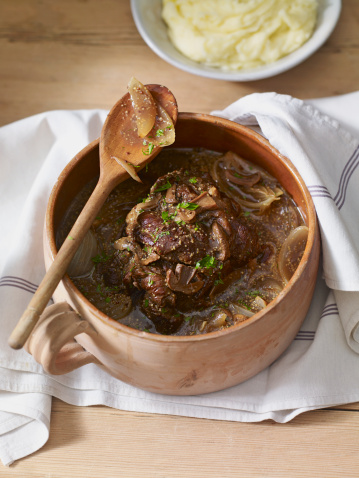
Despite spending a lot of time at the rink watching hockey, most of my talents lie outside of the game. One of my favorite things in the world to do is to cook. And my favorite thing to make is pot roast – a big portion of the cheapest cut of meat from the butcher shop, cooked on low heat for seven hours in bottom-shelf red wine with some onions, carrots and a secret spice mix.

Making good food is a nifty ability to have on its own, but having more or less grown up in the kitchen, I can also appreciate how the process behind cooking has practical applications in sports. Ingredients, technique and (just as importantly) timing is everything when you’re cooking, and those three things matter just as much when you are trying to improve a hockey team.

Continue reading

Hockey Talk: Why the Kings were good at hitting a lot and also just good

Dustin Brown and the Stanley Cup.jpg
Dustin Brown and the Stanley Cup” by JulieAndSteveFlickr: Dustin Brown and the Stanley Cup!. Licensed under CC BY 2.0 via Commons.

Hockey Talk is a (not quite) weekly series where you will get to view the dialogue amongst a few of the Hockey-Graphs’ contributors on a particular subject, with some fun tangents.

This week we look at dump and chase systems and hitting:

Continue reading

#RITHAC Recap with Slides!

After a wildly successful Hockey Analytics Conference at the Rochester Institute of Technology, I wanted to say a few words of gratitude to everyone involved.

First off, this means a huge thank you to all that attended and viewed online. I really appreciate you taking the time out of your weekend to come listen to us all wax on about hockey analytics and things we spend hours laboring on. I feel I can speak for all the speakers when I say, it really does mean a lot to see that support and encouragement. So, thank you.

Next, to Matthew Hoffman and Paul Wenger, both professors at RIT. Matt was instrumental in paving the way to make this happen. Paul was a big hand helping out with the live stream and time-stamping the presentations so quickly after the conference ended. Huge thanks to both of them. Great guys and they deserve a ton of thanks for this event.

Continue reading

Hockey Graphs live video (Pod)cast #2: Tuesday 10/13 at 9PM EST!

The Hockey Graphs Live Video Cast has its second episode tomorrow night at 9PM!  We may be joined by additional members of the HG crew, and now we have an actual season – of more than one hockey league – to talk about!  On the agenda for this cast:

  1.  Interesting things that have happened in the first week of the season.
  2. RITHAC Recap
  3. The NWHL!
  4. 3 on 3 – Thoughts?

Hope you can join us! Again, the cast will be live at : http://www.youtube.com/user/wraithlead8/live

Why linemate and competition metrics may not be as simple as we think

ke9lc2

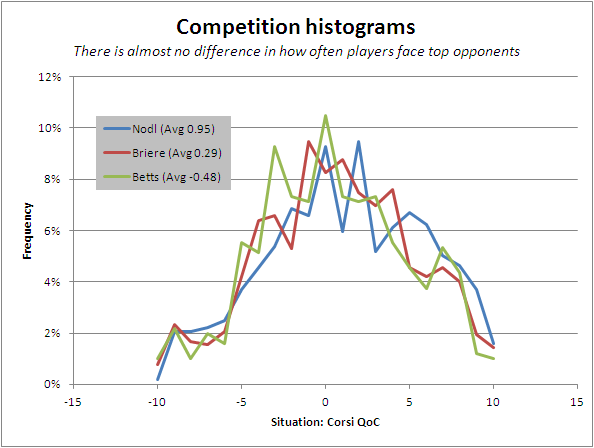
Competition Histograms by Eric Tulsky from NHL Numbers, Sep 23, 2012

ABSTRACT

We know that linemates have a larger impact on results than competition on the average. This has caused many to change player deployment chart axis from QoC to QoT metrics.

However, it’s not quite that simple.

The area of contextually nuanced studies with numbers like competition and teammate metrics is still well in its infancy. We have a general idea of what’s going on but there is a lot of information in the details.

We show here that a 1 percentage point change in teammate and competition Corsi% has an equal but opposite impact on observed output, but there are some differences. The distribution in the NHL is much smaller with competition. However, unlike with competition Corsi%, teammate Corsi% impact is not the same for all players.

Continue reading

Hockey Graphs Top 50 NHL Players

Before the season begins there’s two lists that seem to cause a stir within the hockey community: the Top 50 Players in the NHL. The Hockey News puts out one in its annual season preview yearbook while TSN has an entire hour-long broadcast dedicated to it. Both lists are compiled in the same way (which is why they tend to be similar), and that’s via a poll of people inside hockey. That may be where some of the controversy lies.

It’s not necessarily that those guys are wrong about who’s the best of the best – it’s their job after all – it’s that their opinions tend to be moulded by a few biases that cloud their judgement. From looking at the list every year (and how it changes) it’s shaped a lot by recency bias, reputation and a winning pedigree.

I wanted a different take on the debate so I enlisted some of hockey’s top nerds doing work in the public sphere to share their opinions of who they think will be among the 50 best players in the league in this upcoming season.

Continue reading