Making Better Hockey Graphs

Visualization seems pretty easy, so it’s often left as an afterthought. But visuals can be an immensely effective—or destructive—form of communication. To that end, many, if not most, people fail to tap into its power because of they make prominent mistakes. (Sorry for the ego blow, homies.).

But that need not be the case. Although visualization is a process, not a result, once you know what to look for, you can easily cut down on those big mistakes and make graphs that—while not perfect—will be consistently good.

Here are a few things to keep in mind for hockey bloggers, adapted from Andy Kirk as well as Dieter Rams’ 10 principles of good design.

For our purposes, they can be summed up as “think about your readers while recognizing your practical limitations.”

Continue reading

Probable, ‘Cause: Brodeur’s Record, Karlsson’s Top 5 Chase and Canadian Panic Index

Embed from Getty Images

Probable, ‘Cause is a new feature where the Hockey Graphs staff give their predictions about the big unknowns in the hockey universe today. We’ll offer a question and give the reasons why it will and won’t happen, and then our estimate of the probability that the answer will wind up being yes. At the end of each question you’ll have the chance to submit your predictions as well, and we’ll review the group’s answers in the next edition of Probable, ‘Cause. This week, we’ll look at Braden Holtby’s odds of entering the NHL record books, whether Erik Karlsson can keep up his hot hand, and how nervous broadcasters should be at the prospect of an all-American playoffs this year.

Continue reading

Delta Box Score: a model for predicting player scoring independent of teammate quality


Introduction

One of the greatest challenges in sports analytics is determining the skill of a player independently of quality of teammates. While a number of tools already exist (e.g. WOWYs in hockey), their (mis)use lends itself to significant limitations and collinearity concerns. This is where regression-based approaches can provide a more rigorous alternative in isolating a player’s true talent.  

An encouraging development in hockey analytics as of late has been Ryan Stimson’s Passing Project, which you can read about here. The goal of this post is to introduce a regression-based method to estimate an NHL player’s expected scoring performance independently of the passing strength of his teammates. To this end, player and linemate data from Stimson’s Passing Project and Muneeb Alam of the 2014-2015 season were used to devise a rate-based metric of a player’s projected goals. The difference between a player’s projected goals per 60 minutes and actual goals per 60 minutes will be called Delta Box Score or DBS.

Continue reading

Can defensemen control rebound opportunities? Putting the eye test to the test.

Embed from Getty Images

One of the attributes that is often attached to defensemen is the ability to clear rebounds. You hear this quite often on NHL broadcasts, usually after a flurry of rebound shots that ultimately wind up in a goal. The colour commentator will jump in and imagine the goalie is saying to his defensemen, “I’ll stop the first three, you get the fourth one.”

But just how much is there to defensemen’s ability to prevent rebound shots?
Continue reading

Sportlogiq, Passing, and Playmaking

Embed from Getty Images

Last, week, two pieces were posted that talked about a player’s “playmaking” ability. I put it in quotes because it’s a term that gets tossed around a lot and sometimes isn’t defined by those using it. For example, in this piece from Andrew Berkshire (using data from SportLogiq), it is never clearly defined despite being in the title of the piece. Passes are categorized based on direction (north, south, east-west), zone (offensive zone, neutral zone), or some other qualifiers (to the slot, off the rush), but nowhere are they tied to shots. Passes are charted based on “successful pass volume” per twenty minutes. One can assume these are pass completions per twenty minutes. However, with hundreds of passes completed each game, many of them are simply woven into the noise of the game. We’re interested in what leads to events, specifically exits, entries, shots, and goals. Berkshire includes exit and entry passes, so at least those are present. Nevertheless, despite zero detail on what matters most – creating shots for teammates – Berkshire concludes that “we may be witnessing the beginning of the best playmaker of the next generation of NHL stars in Barkov.”

The other piece I referred to was this by Travis Yost on Joe Thornton. He clearly explains what he means by playmaker”: “To me, a playmaker in the NHL is the guy who routinely creates opportunity for his linemates.” Thornton is without a doubt a 1st ballot Hall-of-Famer and one of the best setup men in the league. It’s only natural to think of the man that once made Jonathan Cheechoo lead the league in goals as one of the greatest playmakers we’ve seen over the last decade. Yost’s definition of creating opportunities for teammates is one I would agree with.

If only there was a publicly available set of data that including passing and shot assist numbers for Barkov and Thornton. Oh, wait… All data is at 5v5 because no one cares about special teams except for Arik Parnass.

Continue reading

2015-16 Hockey Graphs Midseason Awards

Embed from Getty Images

With the league returning from the completely predictable All-Star festivities (I didn’t see the game but can only presume that John Scott screwed the whole thing up, since that’s what Gary Bettman implied would happen), there’s no time like the present to look back at the first 50 games and take stock of the NHL season that’s been so far. And since the only thing better than arbitrary lists or rankings is many arbitrary lists or rankings, we here at Hockey Graphs have put together our picks for each of the end of season major awards.

Continue reading

Redefining Shot Quality: One Pass at a Time

Shot quality has been a topic of late on hockey twitter and various sites. Only a few weeks ago, the Hockey-Graphs Hockey Talk  was centered around this topic. Shot quality is a lightning rod and much of the talking at or past one another that people often do stems from a single issue: there is no agreed-upon definition of what people mean when they say “shot quality.” Well, I like what our own Nick Mercadante had to say on the subject:

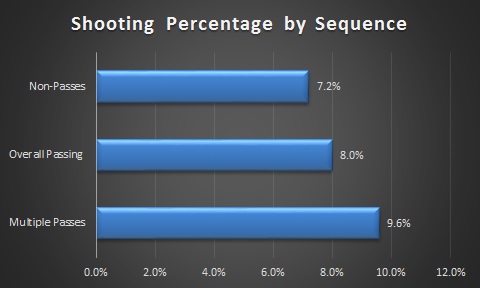
Establishing a base, repeatable skill that accounts for pre-shot movement and an increased likelihood of a goal being scored are what we need to properly analyze player contributions. Quantifying passing also gives us another actionable piece of data that everyone understands and coaches can use as well. Often, the simplest metric or method is the best. And, we should able to do that now that we’ve obtained a significant set of data. This chart may look familiar, but it’s essential to understanding how important passing is to goal-scoring. This is from all tracked passing sequences from the six teams (Chicago Blackhawks, Florida Panthers, New Jersey Devils, New York Islanders, New York Rangers, and Washington Capitals) that we tracked last season.

SH%Sequence

From this point on, I want you to forget whatever it is you think of when you hear the term, “shot quality.”

Continue reading