Practical Concerns: How I do video

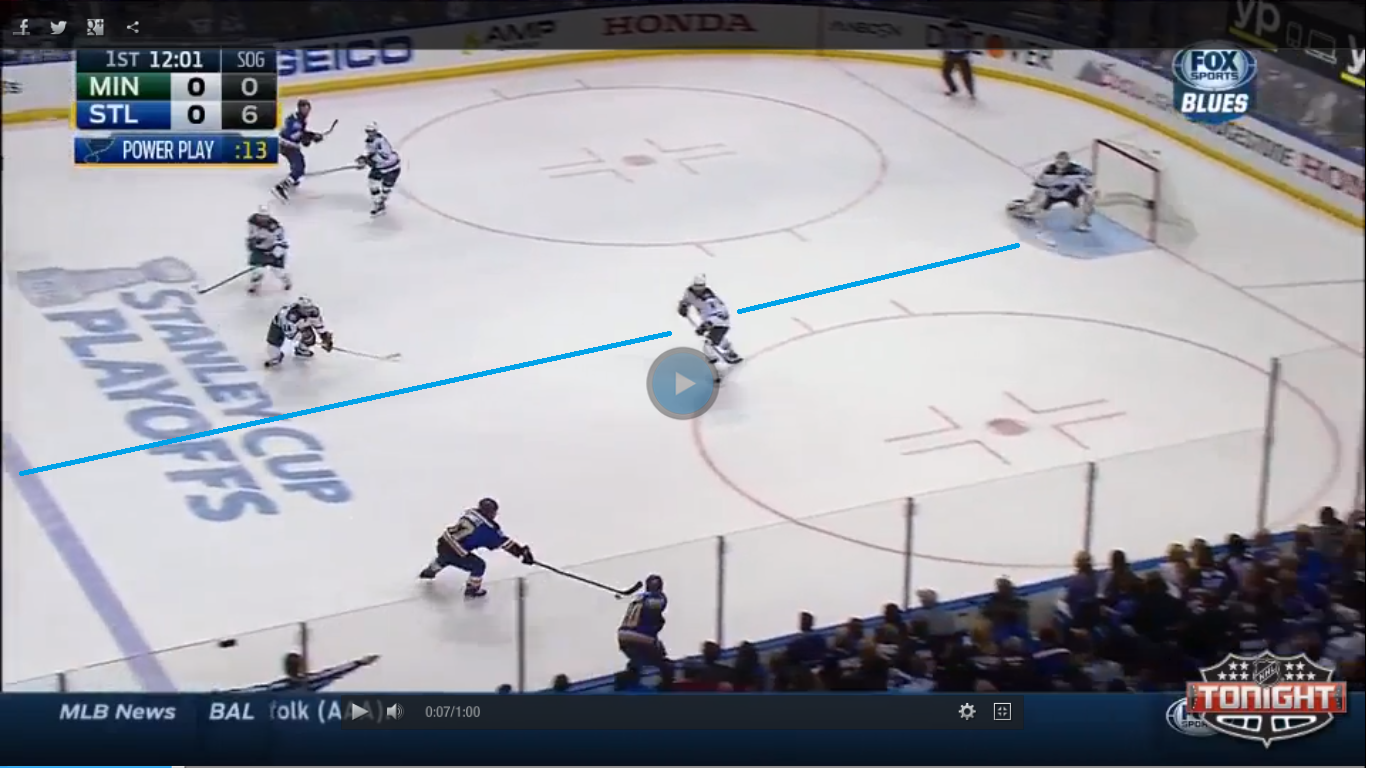
Video is the best teaching tool there is.

Video is the best teaching tool there is.

Preparing and organizing game footage is one of my main responsibilities working for the McGill Martlet hockey team, and has become something that I enjoy quite a bit over the course of the past two seasons. Having played for coaches who use video analysis to various degrees in both hockey and tennis growing up, I think seeing one’s self play sports on video is the best way to correct deficiencies and identify areas for growth.


Continue reading

Practical Concerns: Fixed vs. growth mindsets in hockey analytics

ff

The vast majority of scientific research has indicated that people with growth mindsets tend to be higher-achieving than those with fixed mindsets. Growth-oriented people are the ones who are more interested in furthering their education, or picking up a new hobby, or getting out of their comfort zones to experience new things.

Continue reading

Practice Concerns: Coaching wisdom & redefining consistency

Should all players be treated the same? Probably not.

Should all players be treated the same? Probably not.

A very experienced NHL coach once said something to the effect of:

“The most difficult players to coach are those in the middle of your lineup. Your best players will always be your best, and your depth players are usually just happy to be there. Catering to the second and third liners is the toughest thing, because they’ll often have a different opinion of themselves than you.”

When I first heard this, I thought it made a lot of sense from a psychological point of view. In every team I’ve been a part of, there were three groups of players: those who were on the powerplay, those who wanted to get on the powerplay, and those who know they’ll never be on the powerplay. Usually the second group experiences the most friction with the coaching staff, and I am speaking from personal experience.

Continue reading

Practical Concerns: Why Alfy should do analytics

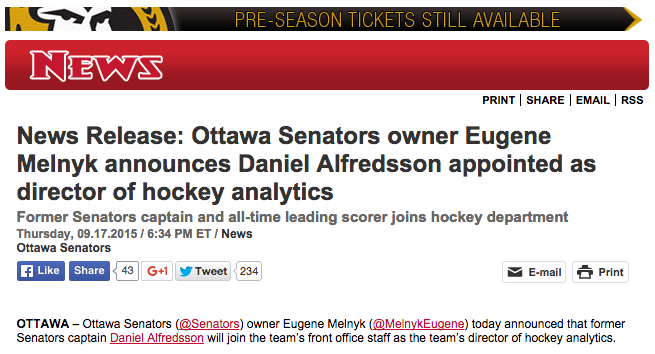
Yesterday, the Ottawa Senators announced the hiring of Daniel Alfredsson as the team’s Senior Advisor to Hockey Operations. Alumni of the Hockey-Graphs blog Emmanuel Perry (who is a Senators fan) took advantage of the situation to come up with this (obvious hoax): https://twitter.com/MannyElk/status/644648872682242048

alf

Now, the more I think about it, the more I believe that having someone like Daniel Alfredsson lead an NHL analytics group is actually a wonderful idea.

Continue reading

Practical Concerns: Why analytics is politics (and what you should know if an NHL team ever comes calling)

bell

Yesterday, I had a nice chat with a member of the hockey media whom I respect a great deal for his habit of “seeking truth from facts” despite often sitting on panels where his co-hosts did not share the same attitude. He reached out to me with questions regarding something I previously published on Hockey-Graphs, and we spent about 20 minutes exchanging information – something I enjoy doing anytime with people who like to think the game.

At one point, his line of questioning turned to the specifics of the work I was doing, some of which I wasn’t really keen on discussing. So I told him:

“Look, what I do for our staff is pretty simple. I do things either to save time, or to reduce guesswork. That’s all there is to it.”

Continue reading

Practical Concerns: Supercharging the Eye Test with Microstats

Analytically-minded hockey people, as a group, tend to dismiss the eye test as biased. There is, of course, some truth in that position. “What you see is not all there is.”

However, I think it would be misguided to look at traditional viewing-based scouting and saying that it just doesn’t work. We shouldn’t forget what makes a human being different – and, in some ways, better – than a machine.

There is no camera as versatile as the human eye, and there is no computer as sophisticated as the human brain. So instead of disempowering those tools, why not try to make them better?

Let’s go back to high school for a second.

Continue reading

Practical Concerns: How To Replace Superstar Goal-Scoring

Photo Credit: Derek DrummondPhoto Credit: Derek Drummond

Earlier this week, I read an interesting story by Frank Seravalli on TSN.ca on Mike Babcock, Phil Kessel and the Toronto Maple Leafs, which is a good read for anything interested in how coaches think. For me, it also illustrate another way analytics could be employed to make a coach’s life a lot easier and take out some of the guesswork inherent in the job.

It was not too surprising to hear that Babcock was already thinking about how to get the most out of his team this season while on vacation, but I am very curious about his thought process behind how best to replace Phil Kessel. But before we start thinking about how to replace Phil Kessel (or his production in aggregate), we need to start thinking about how we are to measure a Phil Kessel’s offensive contribution.

Continue reading

Practical Concerns: What the US Open can tell us about where hockey is headed

2014 US Open (Tennis) - Tournament - Roberto Bautista Agut (14914449990)

I’m a big believer in looking to other sports for inspiration and ideas, whether it’s in terms of cross-training or in terms of analytics. Many smart hockey people I know are big baseball and soccer fans. I’ve never sat through an entire MLB game, and the part that fascinates me the most about soccer is the penalty shootout, so I’m not really part of that group. I think hockey has a lot to learn from Formula One in terms of how to adopt new technology, but I really wished more folks in hockey would pay closer attention to what is going on in tennis.

Continue reading

Practical Concerns: Analytics as technology

As I alluded to in my previous post, the choice of words is very important when selling ideas to a coaching staff. Semantics lets us see the same idea from different angles, and can be a very powerful way to alter our understanding of a subject matter.

Recently, I’ve began to refer to hockey analytics tools (possession metrics, Player Usage Charts, HERO Charts, dCorsi, etc.) as technology, which has allowed me to relate better with those less well-versed on the matter and have all sorts of interesting discussions with people who otherwise wouldn’t give advanced stats the time of day.

Continue reading

It’s not about the numbers: working in analytics for an elite hockey program

Recently, I’ve received some unsolicited emails from some very smart young people about working in analytics for a hockey team. There are definitely people more qualified that they could’ve tracked down, but most of them are not allowed to talk about their jobs, so I guess they were stuck with me.

It felt a little bit strange corresponding with these mathematics or engineering students, because theoretically, their backgrounds are a lot more suited to this line of work than mine (I graduated in Marketing). I apparently passed Calculus II 10 years ago (I barely remember taking it). I’m a mediocre programmer. And I don’t even work in the NHL.

But there are still a few thoughts I could share.

Continue reading